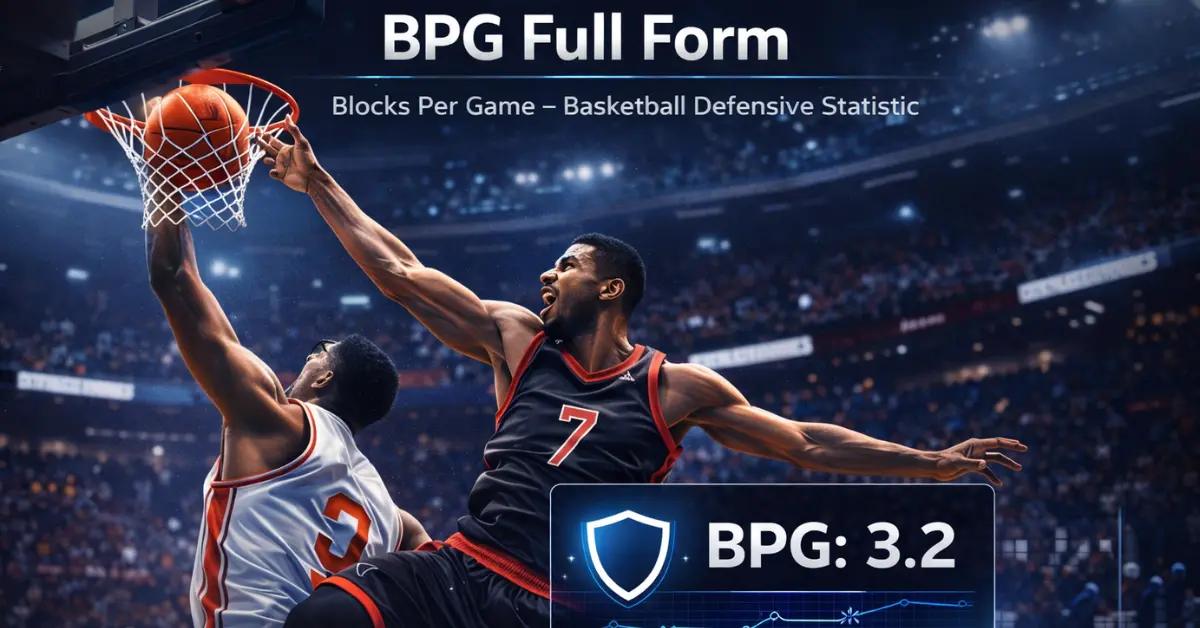

The BPG Full Form is Blocks Per Game.
It is a basketball statistic that measures the average number of blocked shots a player records per game.
In modern basketball analytics, BPG (Blocks Per Game) is one of the most important defensive metrics. While points and assists get headlines, BPG reveals a player’s rim protection, timing, and defensive dominance.
What Is BPG in Basketball? (Blocks Per Game Explained)
Blocks Per Game (BPG) measures how many shots a player blocks on average during a single game.
A block is officially recorded when a defender:
- Legally touches a field goal attempt
- Prevents the ball from reaching the basket
- Directly stops a scoring opportunity
BPG is widely used in:
- NBA statistics
- NCAA college basketball
- FIBA international competitions
- Fantasy basketball leagues
- Advanced sports analytics reports
How Is BPG Calculated?
The formula for calculating BPG is simple:
BPG = Total Blocks ÷ Total Games Played
Example 1:
If a player records 82 blocks in 82 games:
BPG = 82 ÷ 82 = 1.0
This means the player averages one block per game.
Advanced Block Metrics
Modern analytics also use:
- Blocks per 36 minutes
- Blocks per 100 possessions
- Block Percentage (BLK%)
These metrics adjust for playing time and pace, giving deeper insight into defensive impact.
BPG vs Total Blocks – What’s the Difference?
Many fans confuse total blocks with Blocks Per Game.
| Metric | Meaning |
|---|---|
| Total Blocks | Total number of blocked shots in a season or career |
| BPG | Average blocks per game |
Example:
Player A:
200 blocks in 100 games → 2.0 BPG
Player B:
300 blocks in 300 games → 1.0 BPG
Although Player B has more total blocks, Player A is the more dominant rim protector per game.
Why Is BPG Important?
Measures Defensive Impact
Blocked shots prevent immediate scoring opportunities.
Indicates Rim Protection
High-BPG players protect the paint and discourage drives.
Alters Opponent Strategy
Teams avoid attacking elite shot blockers.
Influences Awards
- Strong BPG numbers contribute to:
- Defensive Player of the Year
- All-Defensive Team selections
Crucial in Fantasy Basketball
Blocks are rare compared to points or rebounds. A 2.0+ BPG player gives a competitive advantage.
What Is Considered a Good BPG Average?
| Performance Level | BPG Average |
|---|---|
| Average Player | 0.3 – 0.7 |
| Good Defender | 1.0 – 1.5 |
| Very Good Rim Protector | 1.5 – 2.0 |
| Elite Shot Blocker | 2.0+ |
A player averaging 2 or more blocks per game is generally considered elite.
All-Time NBA Shot Blocking Leaders (Career BPG)
| Player | Career BPG | Total Blocks |
|---|---|---|
| Hakeem Olajuwon | 3.1 | 3,830 |
| Manute Bol | 3.3 | 2,086 |
| Mark Eaton | 3.5 | 3,064 |
| Dikembe Mutombo | 2.8 | 3,289 |
| David Robinson | 3.0 | 2,954 |
These players dominated defensively through elite timing, positioning, and anticipation.
Highest Single-Season BPG Records
Some of the most dominant defensive seasons in NBA history include:
- Mark Eaton – 5.6 BPG (1984–85 season)
- Manute Bol – 5.0 BPG (1985–86 season)
- Hakeem Olajuwon – 4.6 BPG (1989–90 season)
These numbers show how dominant interior defense once was compared to modern pace-and-space basketball.
Modern Era vs 1990s – Why BPG Is Lower Today
In the 1990s:
- More post play
- More paint attacks
- Slower pace
Today:
- More three-point shooting
- Floor spacing
- Faster transitions
Because fewer players attack the rim, average BPG numbers have slightly declined compared to past eras.
Factors That Influence BPG
Several elements impact Blocks Per Game:
- Height and wingspan
- Vertical leap
- Timing and anticipation
- Defensive positioning
- Minutes played
- Team defensive system
- Pace of play
Elite timing can sometimes compensate for lack of height.
Does High BPG Always Mean Great Defense?
Not necessarily.
Some players chase blocks aggressively, which may:
- Lead to fouls
- Create defensive breakdowns
- Leave rebounding gaps
True defensive excellence combines:
- Discipline
- Smart positioning
- Communication
- Team awareness
- Consistency
BPG should be evaluated alongside Defensive Rating (DRTG) and overall team defense.
BPG in Fantasy Basketball
In fantasy leagues:
- Blocks are harder to accumulate
- 2.0+ BPG players provide weekly advantage
- Elite rim protectors improve category rankings
Fantasy managers often draft strong shot blockers early because of category scarcity.
Why Do People Search “BPG Full Form”?
Common reasons include:
- Students preparing for sports exams
- Basketball beginners learning stats
- Fantasy basketball players
- NBA fans analyzing performance
- Sports writers and bloggers
Understanding the BPG Full Form (Blocks Per Game) helps interpret basketball statistics correctly.
Quick Summary
- BPG Full Form stands for Blocks Per Game
- It measures average blocked shots per game
- 1.0 BPG is solid
- 2.0+ BPG indicates elite rim protection
- Used in NBA, NCAA, FIBA, and fantasy basketball
Frequently Asked Questions (FAQs)
What is the BPG full form?
BPG full form is Blocks Per Game.
How do you calculate BPG?
Divide total blocks by total games played.
What is a good BPG average?
Around 1.0 is good; 2.0+ is elite.
Who has the highest career BPG in NBA history?
Mark Eaton holds one of the highest career BPG averages at 3.5.
Is BPG only important for centers?
Centers and power forwards lead in BPG, but guards can also contribute.
Does BPG affect player rankings?
Yes. It significantly impacts defensive evaluations and fantasy rankings.
Final Thoughts
Understanding the BPG Full Form (Blocks Per Game) provides deeper insight into basketball defense. It highlights rim protection, defensive timing, and game-changing impact.
Although BPG alone does not define a complete defender, it remains one of the most important defensive statistics in professional basketball analysis.