
If you follow ice hockey or other goalkeeping sports, you’ve probably seen the term GAA next to a goalie’s name. But what does it really mean?
GAA Full Form
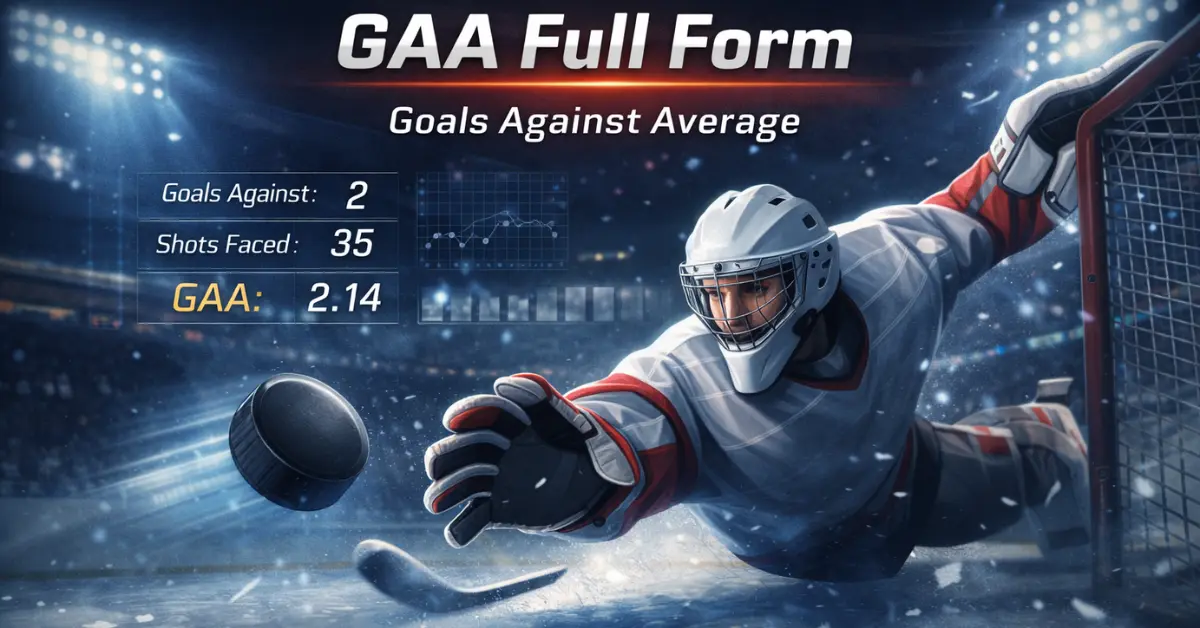
GAA Full Form is Goals Against Average.
It is a key goaltending statistic used mainly in ice hockey to measure the average number of goals a goalie allows per 60 minutes of play.
In simple words:
- GAA shows how many goals a goalkeeper gives up in a full game.
The lower the GAA, the better the performance — in most cases.
What Is Goals Against Average (GAA)?
Goals Against Average (GAA) is a performance metric used to evaluate goalkeepers in sports like:
- Ice Hockey
- Lacrosse
- Water Polo
Soccer (often called goals conceded per game)
In hockey, it is one of the most important goalie statistics alongside:
- Save Percentage (SV%)
- Shutouts (SO)
- Goals Saved Above Average (GSAA)
GAA standardizes performance by calculating goals allowed per 60 minutes, making it easy to compare goalies who played different minutes.
How Is GAA Calculated? (Official Formula)
The official formula for Goals Against Average is:
GAA = (Total Goals Allowed ÷ Total Minutes Played) × 60
Or:
GAA = (Goals Allowed × 60) ÷ Minutes Played
This adjusts performance to a full 60-minute game.
Example Calculation
Example 1: Full Game
- Goals allowed: 2
- Minutes played: 60
GAA = (2 ÷ 60) × 60 = 2.00
Example 2: Partial Game
- Goals allowed: 3
- Minutes played: 45
GAA = (3 ÷ 45) × 60 = 4.00
This means the goalie would allow 4 goals over a full 60-minute pace.
What Does GAA Tell Us?
GAA helps answer:
- How many goals does this goalie allow per game?
- Is the goalie performing better than league average?
- How consistent is their defensive impact?
However, GAA does not measure:
- Shot difficulty
- Number of shots faced
- Defensive support quality
That’s why advanced stats matter too.
Do Empty Net Goals Count in GAA?
No.
When a goalie leaves the ice and the opposing team scores:
- It does NOT count toward GAA.
- It does NOT count toward Save Percentage.
The goalie’s minutes stop once they exit the game.
Does Overtime Count?
Yes.
Overtime minutes count toward GAA because the goalie is still on the ice.
However:
- Shootout goals do NOT affect GAA.
What Is a Good GAA in the NHL?
GAA benchmarks change slightly by era due to scoring trends, but in the modern NHL:
| GAA Range | Performance Level |
|---|---|
| Below 2.20 | Elite |
| 2.20 – 2.50 | Very Good |
| 2.50 – 2.80 | Average |
| Above 2.80 | Below Average |
A GAA under 2.00 is considered outstanding in today’s game.
GAA vs Save Percentage: Which Is Better?
Both stats measure goalie performance — but differently.
GAA
- Measures goals allowed per 60 minutes
- Influenced by team defense
Save Percentage (SV%)
- Measures percentage of shots stopped
- More individual-performance focused
Most analysts prefer using both together.
If forced to choose one, Save Percentage often gives a clearer picture of pure goaltending skill.
Advanced Metrics Beyond GAA
Modern hockey analytics go beyond traditional stats.
1 GSAA (Goals Saved Above Average)
Compares a goalie’s performance to league average.
Shows how many goals they prevented compared to an average goalie.
2xGA (Expected Goals Against)
Estimates goals allowed based on:
- Shot location
- Shot type
- Defensive pressure
- High-danger chances
These stats provide deeper insight than GAA alone.
Why GAA Can Be Misleading
GAA depends heavily on:
- Team defense quality
- Shot suppression systems
- Penalty kill strength
- Defensive turnovers
For example:
A goalie facing 40 shots and allowing 3 goals may perform better than a goalie facing 18 shots and allowing 2 goals — even though the second goalie has a lower GAA.
This is why context matters.
GAA in Different Sports
While most popular in hockey, Goals Against Average is also used in:
- Soccer – Often called goals conceded per match
- Water Polo
- Lacrosse
However, calculation methods may vary slightly depending on the sport’s game duration.
Historical Importance of GAA
GAA has long been a major factor in:
- Vezina Trophy discussions
- Goalie contract negotiations
- Hall of Fame evaluations
- Scouting reports
Even with modern analytics, GAA remains a foundational statistic in hockey.
Quick Summary
- GAA Full Form: Goals Against Average
- Measures goals allowed per 60 minutes
- Lower GAA = better performance (generally)
- Does not account for shot quality
- Best used with Save Percentage and advanced stats
Frequently Asked Questions (FAQ)
What does GAA stand for?
GAA stands for Goals Against Average.
Is lower GAA always better?
Usually yes, but team defense plays a major role.
Does shootout affect GAA?
No, shootout goals are excluded.
What is considered elite GAA?
Below 2.20 in the modern NHL.
Can GAA be zero?
Yes. If a goalie allows no goals, their GAA is 0.00.
Final Thoughts
Understanding GAA Full Form (Goals Against Average) helps fans, analysts, and players evaluate goaltending performance more accurately.
While it is not a perfect statistic, it remains one of the most important traditional metrics in hockey. For a complete evaluation, combine GAA with Save Percentage and advanced analytics like GSAA and xGA.
When used correctly, GAA provides valuable insight into a goalie’s consistency and effectiveness.