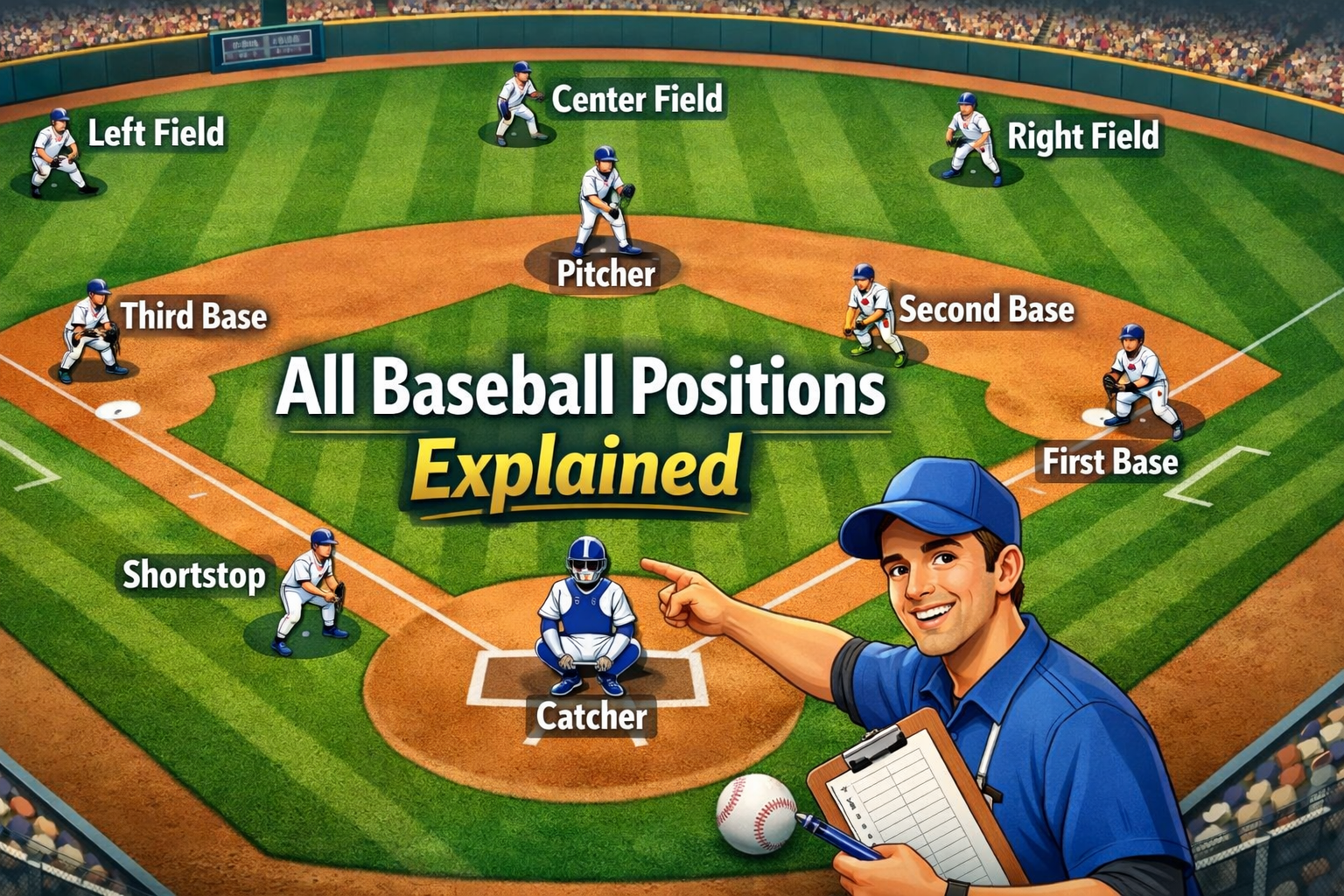

All Baseball Positions Explained – Baseball is a game of strategy and skill, and understanding all positions on the field is essential for players, coaches, and fans. Every player on the field has a unique role, whether it’s pitching, catching, fielding, or batting. Understanding all baseball positions is crucial for players, coaches, and fans to fully appreciate the game.
This guide covers every position, including key responsibilities, skills, and tips that most guides overlook.
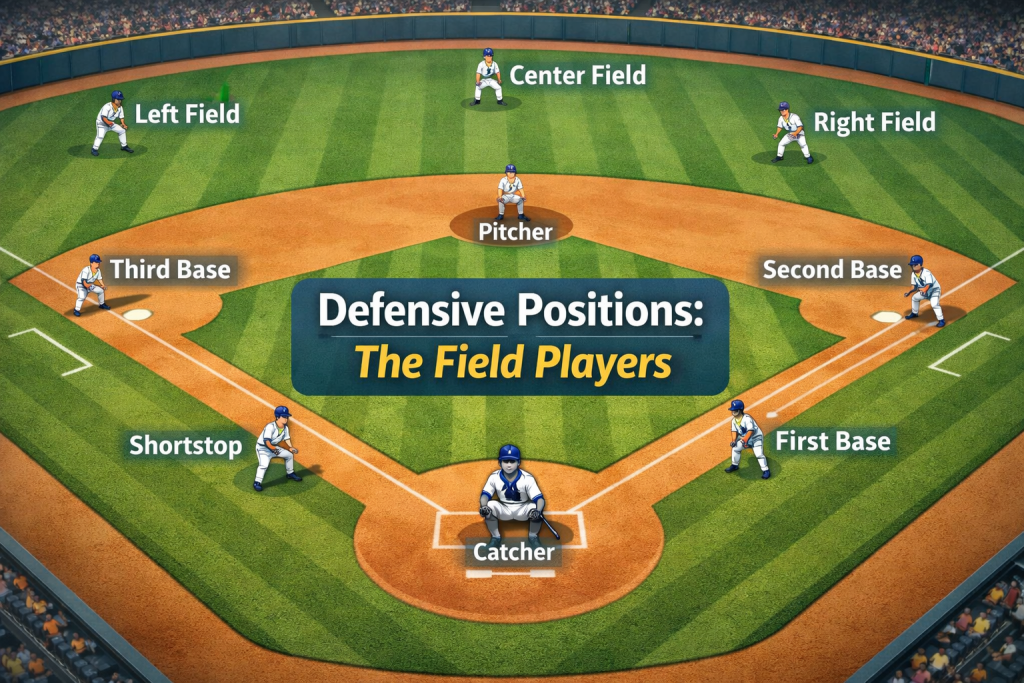
Defensive Positions: The Field Players
Pitcher (P) – The Game Controller
The pitcher starts every play and controls the pace of the game.
Key Responsibilities:
- Throw strikes and prevent hits
- Hold runners on base
- Work with the catcher on pitch selection
- Change tempo to disrupt the batter
Types of Pitchers:
- Starter: Pitches 5–7 innings, manages stamina
- Reliever: Bridges the starter and closer, pitches 1–3 innings
- Closer: High-pressure situations, finishes games
- Skills Needed: Arm strength, focus, accuracy, multiple pitch types (fastball, curve, slider, changeup)
Pro Tip: Effective pitchers use pitch variation, speed changes, and location to outsmart hitters.
Catcher (C) – The Defensive Leader
The catcher is the infield commander, crouched behind home plate.
Key Responsibilities:
- Catch every pitch and block balls in the dirt
- Call pitches and signals for the pitcher
- Direct defensive plays and shifts
- Throw out base runners attempting to steal
Skills Needed: Quick reflexes, strong arm, leadership, strategic thinking
Pro Tip: Catchers often serve as the coach on the field, guiding infielders and outfielders during every play.
First Base (1B) – The Stretch Expert
First basemen catch throws from other infielders and protect the base.
Key Responsibilities:
- Field throws and tag runners
- Catch poorly thrown balls to help teammates
- Assist in double plays or cover second base occasionally
Skills Needed: Height advantage, good catching, quick footwork
Second Base (2B) – The Agile Connector
Second basemen cover the middle right of the infield.
Key Responsibilities:
- Field ground balls and fly balls
- Turn double plays with the shortstop
- Relay throws from outfielders
Skills Needed: Quick hands, fast reactions, teamwork
Tip: The second baseman must communicate constantly with the shortstop to execute plays smoothly.
Shortstop (SS) – The Athletic Anchor
Shortstops cover between second and third base, often handling the most ground balls.
Key Responsibilities:
- Field hard-hit balls
- Cover bases during steals or double plays
- Act as infield captain
Skills Needed: Agility, arm strength, quick decision-making, excellent range
Pro Insight: Shortstops often face the most balls because most hitters are right-handed and pull the ball.
Third Base (3B) – The Hot Corner
Third basemen must react quickly to sharply hit balls.
Key Responsibilities:
- Field line drives and ground balls
- Throw long distances to first base
- Cover bunts and the left field line
Skills Needed: Reflexes, strong arm, anticipation
Left Field (LF) – The Opportunist
Left fielders cover the left side of the outfield and often assist in backup plays.
Key Responsibilities:
- Catch fly balls and line drives
- Field balls and throw accurately to bases
- Support infielders with backup throws
Skills Needed: Speed, catching, reliable arm
Center Field (CF) – The Outfield Captain
Center fielders cover the most ground in the outfield.
Key Responsibilities:
- Track and catch fly balls
- Communicate with left and right fielders
- Prevent runners from advancing
Skills Needed: Speed, agility, judgment, strong arm
Pro Tip: Center fielders often direct the outfield, ensuring no balls fall between players.
Right Field (RF) – The Long-Arm Specialist
Right fielders often need the strongest throwing arms.
Key Responsibilities:
- Catch fly balls and line drives
- Make long throws to third base or home plate
- Support center fielders in overlap areas
Skills Needed: Arm strength, quick reaction, field awareness
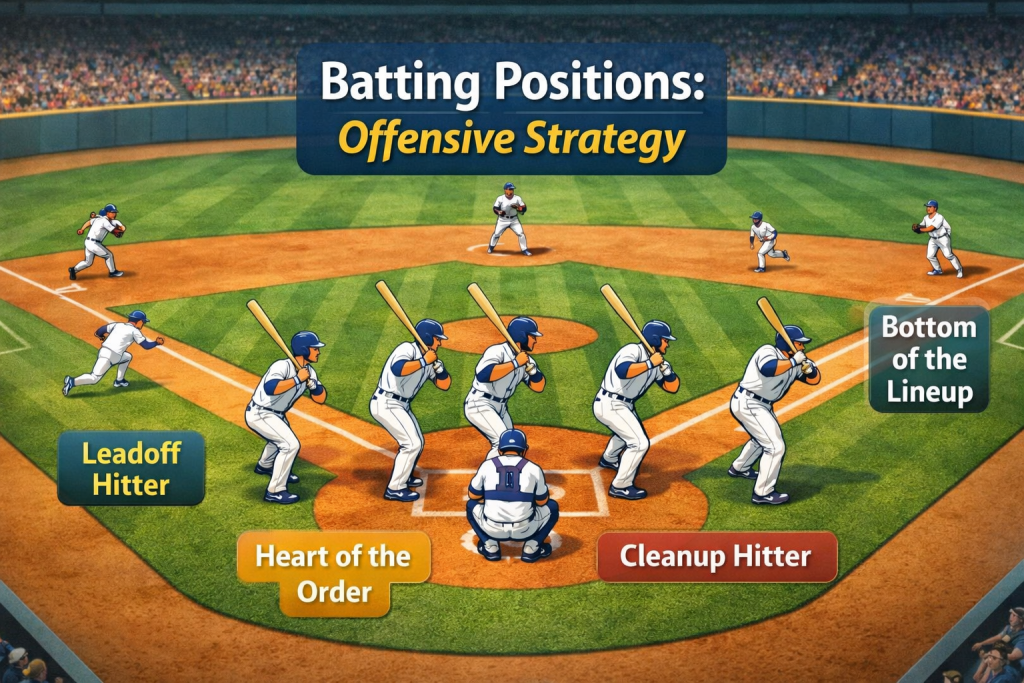
Batting Positions: Offensive Strategy
Key Batting Roles
- Leadoff Hitter: Fast and consistent, aims to get on base
- No. 2 Hitter: Contact hitter, often bunts to advance runners
- Cleanup Hitter (4th): Power hitter, drives in runs
- Heart of the Order (3rd–6th): Strong hitters for scoring opportunities
- Bottom of Lineup (7th–9th): Often defensive specialists or weaker hitters
- Pinch Hitter / Runner: Substitute for strategic advantage
- Designated Hitter (DH): Bats for pitcher, does not field
Pro Tip: Managers can adjust the batting order for strategy, using power hitters at leadoff or specialized pinch hitters.
Youth Player Tips and Common Mistakes
Tips for Beginners:
- Rotate players to learn multiple positions
- Focus on footwork, throwing accuracy, and catching fundamentals
- Communicate constantly; baseball is teamwork
- Track performance and specialize over time
Common Mistakes:
- Infielders overcommitting and missing cut-off plays
- Outfielders failing to communicate on fly balls
- Pitchers not holding runners
- Batters neglecting situational awareness
Extra Insights Competitors Often Miss
- Mental Game: Baseball is as much about focus and decision-making as skill. Pitchers, catchers, and field leaders constantly read the game.
- Field Awareness: Outfielders must consider wind, sun, and field dimensions for optimal positioning.
- Positional Flexibility: Players who can switch positions add huge strategic value to a team.
- Analytics Influence: Modern baseball uses stats to position players, set pitching strategies, and design batting lineups—data-driven decisions are key at all levels.
FAQs
What are the nine positions in baseball?
The nine positions are: Pitcher (P), Catcher (C), First Base (1B), Second Base (2B), Shortstop (SS), Third Base (3B), Left Field (LF), Center Field (CF), and Right Field (RF). Each has a unique role in defense and teamwork.
What does a pitcher do?
The pitcher throws the ball to the batter, trying to get them out. They can be starters, relievers, or closers. A pitcher also controls the pace of the game and must prevent base runners from stealing bases.
Why is the catcher important?
Catchers lead the infield defense, catch pitches, call the game, direct fielders, and throw out runners attempting steals. They act as on-field strategists for the pitcher and the team.
What is the role of infielders?
Infielders (1B, 2B, SS, 3B) field ground balls, catch pop-ups, and cover bases. They often participate in double plays and must communicate effectively to prevent scoring.
What skills do outfielders need?
Outfielders (LF, CF, RF) need speed, strong throwing arms, quick reflexes, and good judgment to catch fly balls and relay hits back to the infield. Center Fielders are often the fastest and act as outfield captains.
What is a designated hitter (DH)?
A DH bats in place of the pitcher in certain leagues. They do not play defense but focus on hitting and generating runs.
How is the batting order determined?
Managers arrange batters to maximize scoring chances. The leadoff hitter is usually fast and consistent, while the cleanup hitter is a power hitter. Middle-of-the-order batters drive in runs, and the bottom-of-the-lineup often features defensive specialists.
Can players play multiple positions?
Yes, many players are versatile and can play infield, outfield, or even pitch if needed. This flexibility helps teams adjust strategies during games.
Why is the shortstop considered one of the hardest positionWhat are some common mistakes beginners make?s?
Shortstops cover a large area, handle more ground balls than most positions, execute double plays, and must have strong arms, quick reflexes, and excellent decision-making skills.
What are some common mistakes beginners make?
Infielders overcommitting and missing cutoff plays
Outfielders failing to communicate on fly balls
Pitchers not holding runners on base
Batters neglecting situational awareness, like advancing runners
How can beginners improve at different positions?
Practice footwork, throwing accuracy, and catching fundamentals. Rotate positions to learn the field fully and focus on communication with teammates.
Conclusion
Understanding all baseball positions is essential for players, coaches, and fans. From pitchers controlling the game to outfielders covering vast territory and batters driving runs, each role contributes to a team’s success. Mastering positions, teamwork, and strategy ensures a deeper appreciation of the game.