
Introduction
If you regularly watch American football, analyze player statistics, or play fantasy football, you have likely seen the term YPG on scoreboards, stat sheets, or sports websites. Many beginners see this abbreviation but do not fully understand what it represents or why it matters.
YPG is not just another random football stat. It is one of the most important performance indicators used to evaluate players, teams, offensive strength, and defensive efficiency.
In this complete guide, you will learn:
- The exact YPG full form
- Its meaning in football
- How to calculate it
- Offensive vs defensive YPG
- NFL benchmarks and elite ranges
- YPG in fantasy football
- Differences between YPG and other stats
- Limitations and advanced analysis
Let’s break it down step by step.
YPG Full Form in Football
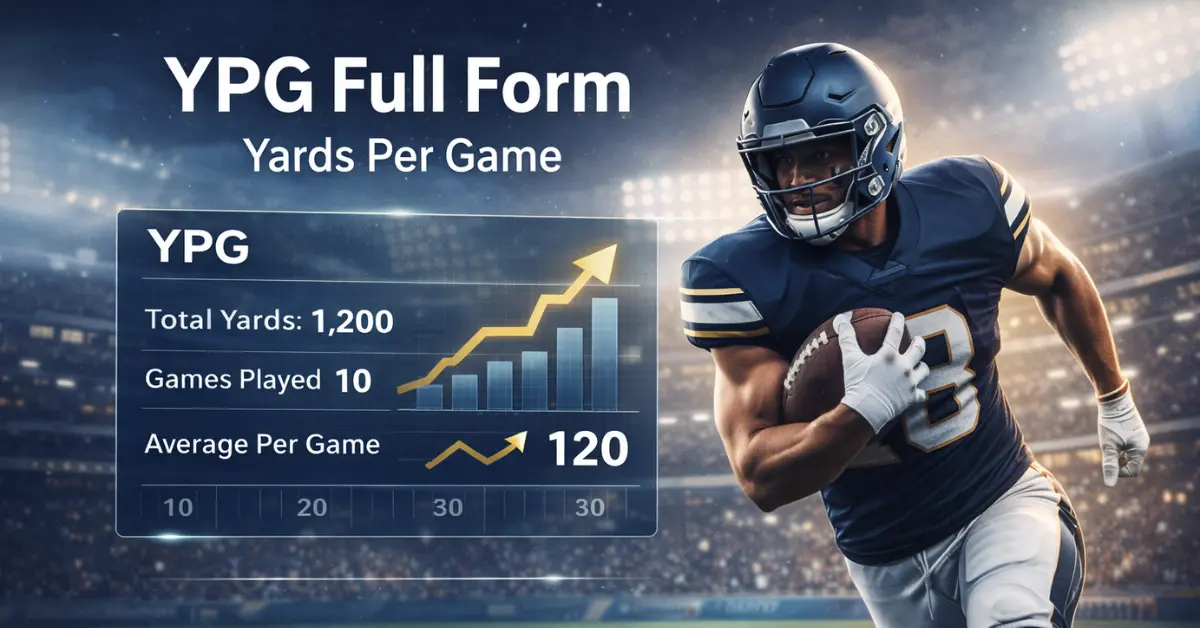
The YPG full form in football is Yards Per Game.
It refers to the average number of yards a player or team gains (or allows) per game over a specific period, usually a season.
This metric helps measure consistency and average production rather than just total yardage.
Quick Definition
YPG in football stands for Yards Per Game. It measures the average number of yards gained or allowed per game by dividing total yards by total games played. It is used to evaluate offensive production, defensive performance, and player consistency.
What Does YPG Mean in Simple Terms?
In simple words, YPG shows how many yards a player or team produces in each game on average.
Instead of looking at total yards across an entire season, YPG gives a per-game performance average. This makes it easier to compare:
- Players who have played different numbers of games
- Teams with different schedules
- Offensive and defensive efficiency
It smooths out extreme performances and shows overall consistency.
How to Calculate YPG (Formula Explained)
The formula is straightforward:
YPG = Total Yards ÷ Total Games Played
Example 1: Player YPG
A quarterback throws for 4,500 yards in 17 games.
4,500 ÷ 17 = 264.7 YPG
This means the quarterback averages approximately 265 passing yards per game.
Example 2: Team Offensive YPG
A team records 6,000 total offensive yards in a 17-game season.
6,000 ÷ 17 = 352.9 YPG
That team averages about 353 total yards per game.
Types of YPG in Football
YPG applies to multiple aspects of the game.
Offensive YPG
Offensive YPG measures how many total yards a team gains per game.
It includes:
- Passing yards
- Rushing yards
- Total offensive production
High offensive YPG usually indicates a strong, productive offense.
In the National Football League, teams averaging 380–400+ YPG are typically ranked among the top offenses.
Defensive YPG
Defensive YPG measures how many yards a team allows per game.
Lower defensive YPG is better because it means:
- The defense limits opponent movement
- Fewer sustained drives
- Better field position control
Elite NFL defenses often allow under 320 yards per game.
Individual Player YPG
YPG is also used to evaluate individual players:
- Passing YPG (quarterbacks)
- Rushing YPG (running backs)
- Receiving YPG (wide receivers)
This shows how consistent a player performs week after week.
Real NFL Context: Why YPG Matters
In the National Football League, YPG is one of the primary metrics used to rank teams offensively and defensively.
For example:
- Quarterbacks like Patrick Mahomes regularly average over 280 passing YPG during strong seasons.
- Elite running backs such as Christian McCaffrey often average 90–100+ rushing YPG in peak years.
Teams that consistently rank top 5 in offensive YPG are frequently playoff contenders because sustained yardage production often correlates with scoring opportunities.
What Is Considered a Good YPG?
The definition of “good” depends on position and league trends.
Quarterbacks
- 250+ passing YPG = strong season
- 300+ passing YPG = elite level
Running Backs
- 80–100 rushing YPG = solid performance
- 100+ rushing YPG = top-tier production
Wide Receivers
- 70–90 receiving YPG = productive
- 100+ receiving YPG = elite season
Team Offense
350–370 YPG = above average
380–400+ YPG = elite offense
Team Defense
Under 320 YPG allowed = strong defense
Under 300 YPG allowed = elite defense
These benchmarks may vary depending on era and offensive trends.
Why YPG Is Important in Fantasy Football
YPG plays a major role in fantasy football strategy.
Fantasy scoring typically rewards:
- Passing yards
- Rushing yards
- Receiving yards
Players with high YPG are often:
- More consistent
- Less risky
- Reliable weekly starters
However, fantasy managers must also evaluate:
- Touchdowns
- Red zone usage
- Target share
- Snap percentage
- Injury history
High YPG does not automatically guarantee high fantasy points if scoring opportunities are limited.
YPG vs Other Football Statistics
Many people confuse YPG with other common football metrics.
- YPG – Yards Per Game
Measures total yardage volume per game. - YPA – Yards Per Attempt
Measures efficiency per throw or rush attempt. - YAC – Yards After Catch
Measures yards gained after a receiver catches the ball. - PPG – Points Per Game
Measures scoring output per game.
- YPG focuses on volume.
- YPA focuses on efficiency.
- PPG focuses on scoring.
Each metric tells a different part of the story.
Limitations of YPG
Although YPG is important, it is not perfect.
Garbage Time Inflation
A team trailing late may accumulate yards when the defense is playing soft coverage.
Does Not Measure Scoring
A team may gain 400 yards but score few touchdowns.
Efficiency Is Not Reflected
A quarterback may throw 50 passes to reach 300 yards. That may not be efficient.
Game Script Impact
Teams leading by large margins may run the ball more, lowering passing YPG.
Because of these limitations, analysts combine YPG with advanced metrics like yards per play and red zone efficiency.
Historical Evolution of YPG
Football has evolved significantly over the decades.
Modern offenses emphasize:
- Pass-heavy schemes
- Spread formations
- Faster tempo
As a result, average passing YPG in today’s NFL is significantly higher than in earlier decades.
In the 1980s and 1990s, 250 passing YPG was considered elite. Today, multiple quarterbacks exceed that mark regularly.
This context is important when comparing players from different eras.
How Coaches and Analysts Use YPG
Professional coaching staffs use YPG to:
- Analyze opponent strengths
- Identify defensive weaknesses
- Prepare game strategies
- Compare league rankings
Sports analysts use YPG to:
It remains a foundational statistic in football analytics.
Frequently Asked Questions
What is the YPG full form in football?
YPG stands for Yards Per Game. It measures the average number of yards gained or allowed per game.
Is higher YPG better?
Yes for offensive players and teams. For defense, lower YPG allowed is better.
Does YPG include touchdowns?
No. YPG measures yardage only, not scoring.
Is YPG important in fantasy football?
Yes. High YPG often indicates consistent weekly production, which is valuable in fantasy leagues.
How is YPG different from total yards?
Total yards show overall season production. YPG shows average performance per game.
Final Thoughts
Understanding the YPG full form in football is essential for anyone following American football statistics. YPG, which stands for Yards Per Game, measures the average number of yards a player or team gains or allows per game by dividing total yards by total games played. This statistic provides valuable insight into consistency, offensive productivity, defensive strength, and player reliability. While it does not directly account for efficiency or scoring, YPG remains a foundational metric in football analysis, and when combined with efficiency metrics, scoring data, and game context, it becomes a powerful tool for evaluating overall team and player performance.