
Football is a game of strategy, speed, and powerful defensive plays. One defensive statistic that often appears in match reports and player stats is TFL. Understanding TFL helps fans, analysts, and coaches better appreciate how defenders disrupt offensive plays and create difficult situations for the opposing team.
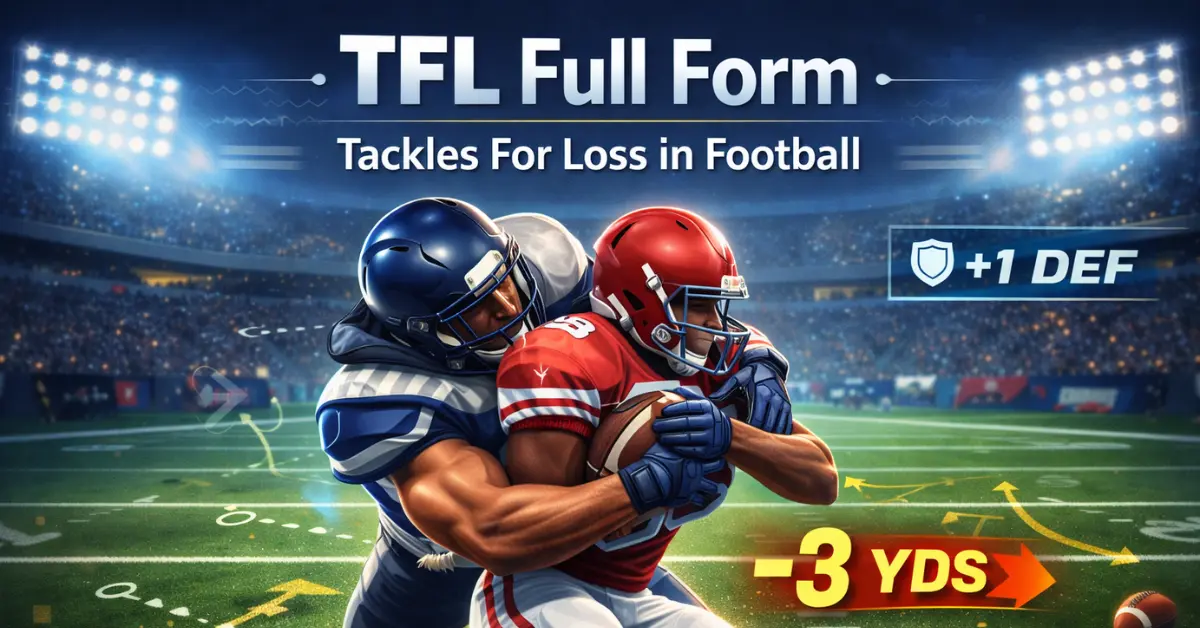
In simple terms, a TFL is a Tackle for Loss, where a defensive player tackles the ball carrier behind the line of scrimmage, resulting in negative yards for the offense. While it may seem straightforward, TFLs are a key indicator of defensive skill, timing, and strategic execution.
Quick Answer
TFL full form: Tackles for Loss
Meaning: A defensive play where a defender tackles the ball carrier behind the line of scrimmage, causing the offense to lose yards.
Important rule:
Every sack is counted as a TFL, but not every TFL is a sack.
Simple Examples
Example 1
Running back receives the ball but is tackled 2 yards behind the line of scrimmage.
Result: TFL (-2 yards)
Example 2
Quarterback drops back to pass and is tackled 7 yards behind the line.
Result: Sack (+ TFL)
TFL Full Form in Football
TFL stands for Tackles for Loss. It means a defender stops the ball carrier behind the line of scrimmage, causing negative yardage for the offense.
TFLs can occur during:
- Running plays
- Screen passes
- Quarterback runs
- Passing plays that result in sacks
Because of this, TFL is considered a strong indicator of defensive disruption.
What Does TFL Mean in Football?
A Tackle for Loss (TFL) occurs when a defender tackles the ball carrier before they reach the line of scrimmage, resulting in lost yards.
This includes tackles on:
- Running backs
- Quarterbacks
- Wide receivers on screen plays
- Tight ends or other ball carriers
TFLs show a defense’s ability to:
- Read offensive plays
- Break through the offensive line
- Disrupt the offense before a play develops
The Mechanics of a Tackle for Loss
A Tackle for Loss usually happens when defenders such as linebackers, defensive linemen, or safeties break through the offensive line quickly and tackle the ball carrier before the play develops.
Key factors in executing a TFL include:
- Penetration
Quickly breaking through blockers. - Anticipation
Reading the play before it unfolds. - Agility & Speed
Reaching the ball carrier before they reach the line. - Strength
Bringing down the opponent behind the line of scrimmage.
Key Skills Needed to Record a TFL
Defensive players who consistently make TFLs typically possess:
- Quick reaction time
- Strong game awareness
- Physical strength
- Consistency in reading plays
- Ability to penetrate offensive gaps
TFL vs Sack (Comparison Table)
| Metric | Definition | Includes QB? | Use Case |
|---|---|---|---|
| TFL (Tackles for Loss) | Tackles resulting in negative yards | Yes | Measures overall disruption against run and pass |
| Sack | Tackling the QB behind the line during a pass attempt | Yes | Evaluates pass-rush success |
A sack is a type of TFL, but TFL also includes tackles on running plays and other ball carriers.
TFL in Football Statistics
TFL is an important defensive statistic used by coaches, analysts, and scouts to evaluate performance.
TFL statistics help measure:
- Run-stopping ability
- Defensive penetration
- Gap control
- Overall defensive disruption
High TFL numbers usually indicate a dominant defensive front.
Average TFL Per Game in NFL
Elite defenders often average around 0.8–1.2 TFL per game over a full season.
Top NFL defenses typically generate about 5–7 TFL per game, depending on the team’s defensive style and opponent strength.
Teams with higher TFL numbers often show stronger performance in:
- Run defense
- Field position control
- Defensive pressure
Real-World Impact: How TFL Predicts Team Success
Teams that consistently produce high TFL numbers often disrupt offensive rhythm.
TFLs create difficult situations for offenses by:
- Forcing longer 2nd and 3rd downs
- Breaking offensive momentum
- Increasing chances of punts or turnovers
Because of this, TFL is widely considered one of the best indicators of defensive disruption.
Notable TFL Leaders (Examples)
Several NFL defenders are known for consistently producing TFLs.
Examples include:
- Aaron Donald
A dominant defensive lineman known for penetrating offensive lines. - Khalil Mack
An elite edge rusher with speed and strength. - J.J. Watt
Famous for record-breaking defensive seasons. - Bobby Wagner
A linebacker known for intelligence and tackling efficiency. - Kenny Logan Jr.
A safety who excels in blitzing and attacking the backfield.
How TFL Affects Down & Distance Strategy
TFLs dramatically change offensive strategy.
They often:
- Force longer 2nd or 3rd down situations
- Push offenses into passing situations
- Increase defensive control of field position
When offenses face 3rd-and-long, defenses gain a significant advantage.
Actionable TFL Insight: What Fans & Coaches Can Do
To better evaluate defensive performance using TFL:
- Track TFL per game
- Analyze down and distance situations
- Compare TFL to total tackles
- Consider the strength of opposing offenses
These factors help determine how impactful a defender truly is.
Common Mistakes People Make About TFL
Some common misunderstandings about TFL include:
- Confusing sacks with TFLs
All sacks are TFLs, but not every TFL is a sack. - Counting tackles past the line of scrimmage
Only tackles behind the line count as TFL. - Ignoring situational context
Down, distance, and opponent strength matter. - Focusing only on total numbers
Efficiency per snap can be more meaningful.
TFL in Fantasy Football
TFLs are also valuable in fantasy football leagues that track defensive statistics.
Fantasy players often monitor:
- Defensive players with high TFL totals
- Linebackers with strong run defense
- Safeties used in blitz packages
Tracking TFL stats can provide an edge in defensive scoring formats.
How Coaches Increase TFL Opportunities
Coaches design defensive strategies to increase backfield penetration.
Common techniques include:
- Blitz packages
- Gap control strategies
- Detailed film study
- Speed and agility training drills
These methods improve the chances of defenders reaching the backfield quickly.
TFL in College Football vs the NFL
| Level | Frequency | Factors |
|---|---|---|
| College Football | Slightly higher | More varied offensive systems |
| NFL | Lower | Stronger offensive lines and faster gameplay |
Because of player development differences, college football often sees slightly more TFL plays.
The Historical Significance of TFLs in the NFL
Throughout NFL history, TFLs have defined some of the most dominant defensive performances.
Players like J.J. Watt and Aaron Donald have built reputations for their ability to consistently disrupt plays in the backfield.
These performances often shift momentum and influence the outcome of games.
Future of TFL in Football
As football evolves:
- New offensive schemes will challenge defenses
- Defensive training techniques will continue improving
- Analytical tools will better measure defensive impact
Despite these changes, TFL will remain a key defensive statistic.
FAQs
What is the TFL full form in football?
TFL stands for Tackles for Loss, meaning a defender tackles the ball carrier behind the line of scrimmage.
Does a sack count as a TFL?
Yes. Every sack is included in a player’s TFL total.
Which players record the most TFLs?
Defensive linemen, linebackers, and blitzing safeties typically lead in TFL statistics.
Why are TFL statistics important?
TFL stats measure defensive disruption, efficiency, and a team’s ability to stop offensive plays early.
Conclusion
TFLs are game-changing defensive plays that disrupt offensive drives and shift game momentum.
By tracking TFL statistics, fans, analysts, and coaches gain deeper insight into defensive performance and strategy.
Understanding TFL helps reveal how defenders control the game by stopping plays before they even begin.