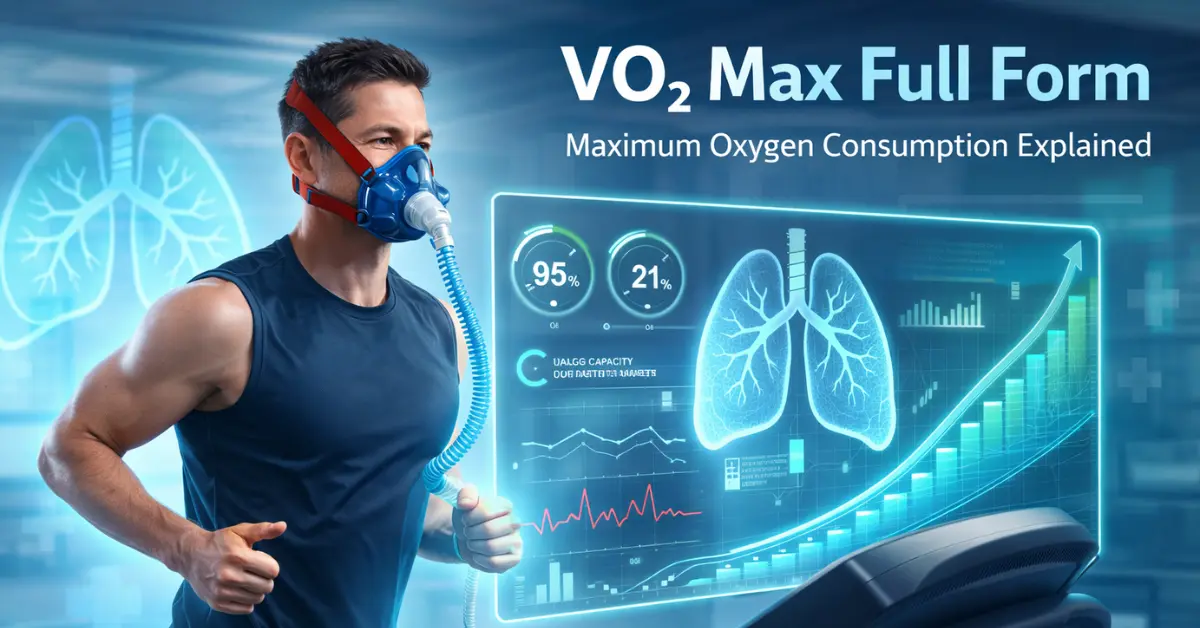

If two people run the same distance, why does one finish strong while the other struggles to breathe? The difference often comes down to VO2 max, a powerful fitness metric that measures how efficiently your body uses oxygen and serves as one of the most reliable indicators of cardiovascular endurance and overall physical fitness. Understanding the VO2 Max full form, how it works inside your body, and how you can improve it allows you to train smarter, increase stamina, and support your long-term health, and this guide breaks it down in simple, practical language so both beginners and athletes can clearly understand and apply it.
What is the VO2 Max Full Form?
VO2 Max Full Form “Volume of Oxygen Maximum.”
It refers to the maximum amount of oxygen your body can use during intense exercise.
It is typically measured in:
- milliliters of oxygen per kilogram of body weight per minute (mL/kg/min).
In simple terms:
- VO2 max measures how efficiently your heart, lungs, and muscles work together to supply and use oxygen during physical activity.
- The higher your VO2 max, the better your body is at producing energy — allowing you to exercise longer and harder without fatigue.
Why is VO2 Max Important?
VO2 max is often called the gold standard of aerobic fitness because it reflects how well your cardiovascular system performs under stress.
A higher VO2 max is associated with:
- Better endurance
- Improved heart health
- Increased lung capacity
- Faster athletic recovery
- Lower risk of chronic diseases
- Greater longevity
Research consistently shows that individuals with higher aerobic capacity tend to live longer and maintain better quality of life as they age.
How VO2 Max Works (Simple Explanation)
Think of your body like a car engine.
- Oxygen acts as the fuel.
- Your heart is the pump.
- Your lungs deliver oxygen.
- Your muscles use it to create energy.
- A small engine burns fuel quickly and slows down.
- A powerful engine uses fuel efficiently and keeps going.
That efficiency is your VO2 max.
What is Considered a Good VO2 Max?
VO2 max varies based on several factors:
- Age
- Gender
- Fitness level
- Genetics
- Training history
Below is a general reference chart.
Average VO2 Max by Age (Men)
| Age | Poor | Average | Good | Excellent |
|---|---|---|---|---|
| 20–29 | <38 | 38–48 | 49–55 | 56+ |
| 30–39 | <35 | 35–45 | 46–52 | 53+ |
| 40–49 | <31 | 31–41 | 42–46 | 47+ |
| 50+ | <26 | 26–35 | 36–41 | 42+ |
Average VO2 Max by Age (Women)
| Age | Poor | Average | Good | Excellent |
|---|---|---|---|---|
| 20–29 | <30 | 30–37 | 38–44 | 45+ |
| 30–39 | <27 | 27–33 | 34–40 | 41+ |
| 40–49 | <24 | 24–30 | 31–35 | 36+ |
| 50+ | <20 | 20–26 | 27–31 | 32+ |
Elite endurance athletes may reach values above 70–85 mL/kg/min, which demonstrates extraordinary cardiovascular efficiency.
Absolute vs Relative VO2 Max
Understanding the two main types helps interpret your results more accurately.
Absolute VO2 Max
- Measures total oxygen consumed per minute
- Expressed in liters per minute (L/min)
- Often used in laboratory testing
Relative VO2 Max
- Adjusted for body weight
- Expressed in mL/kg/min
- Better for comparing fitness between individuals
Most fitness trackers and performance tests rely on relative VO2 max.
How is VO2 Max Measured?
Laboratory Testing (Most Accurate)
This test involves exercising on a treadmill or stationary bike while wearing a metabolic mask that measures oxygen intake and carbon dioxide output.
- Intensity increases gradually until exhaustion, ensuring the most precise reading.
- Although highly accurate, these tests are expensive and typically used by athletes or in medical settings.
Submaximal Fitness Tests
These estimate VO2 max without requiring maximum effort.
Common methods include:
- Cooper 12-minute run
- 1-mile walk test
- Step test
- Cycling protocols
While slightly less accurate, they provide a reliable fitness baseline.
Smartwatches and Fitness Trackers
- Modern wearables estimate VO2 max using heart rate, pace, and activity data.
- Although not as precise as lab tests, they are useful for tracking progress over time.
- Consistency matters more than absolute perfection.
Factors That Affect VO2 Max
Several biological and lifestyle factors influence your aerobic capacity.
Age
VO2 max naturally declines about 5–10% per decade after your mid-20s. However, regular exercise can slow this decline significantly.
Genetics
- Studies suggest genetics account for 40–70% of VO2 max differences between individuals.
- Some people are naturally predisposed to higher endurance.
Training
- The most controllable factor.
- Structured exercise can improve VO2 max by 15–25% in many individuals.
Body Composition
Higher body fat percentages may lower relative VO2 max since oxygen use is measured against total body weight.
Altitude
Living at higher elevations can temporarily improve oxygen efficiency once the body adapts.
VO2 Max vs Endurance: Are They the Same?
Not exactly.
VO2 max represents your maximum oxygen capacity, while endurance reflects how long you can sustain effort.
Another key metric is the lactate threshold — the point at which fatigue-causing lactate builds faster than your body can clear it.
Athletes with slightly lower VO2 max can outperform others if they have superior lactate thresholds.
This proves VO2 max is powerful, but not the only predictor of performance.
Warning Signs of a Low VO2 Max
A very low score may indicate poor cardiovascular fitness.
Possible signs include:
- Quick exhaustion during mild activity
- Shortness of breath
- Slow recovery after exercise
- Elevated resting heart rate
Improving aerobic fitness can dramatically enhance daily energy levels.
Benefits of Increasing Your VO2 Max
Raising your VO2 max delivers more than athletic advantages.
It supports total-body health.
Key benefits include:
- Stronger heart function
- Improved circulation
- Better metabolism
- Reduced risk of heart disease
- Enhanced brain health
- Improved sleep quality
- Greater stamina
Some researchers even consider VO2 max one of the strongest predictors of longevity.
How to Improve Your VO2 Max (Proven Strategies)
High-Intensity Interval Training (HIIT)
Short bursts of intense effort followed by recovery periods push your cardiovascular system to adapt quickly.
Example:
- Sprint for 30 seconds, walk for 60 seconds, repeat.
- HIIT is widely considered the fastest method for increasing VO2 max.
Steady-State Cardio
- Activities such as running, cycling, rowing, and swimming build aerobic capacity over time.
- Aim for 150–300 minutes per week of moderate exercise.
Progressive Overload
- Gradually increase workout intensity or duration.
- Your body improves only when challenged beyond its comfort zone.
Train Near Your Limit
Workouts performed at 90–95% of your maximum heart rate are particularly effective for boosting oxygen utilization.
Maintain Consistency
- Fitness gains are cumulative.
- Even small improvements compound over months.
Can You Improve VO2 Max at Any Age?
Yes.
While younger individuals typically have higher values, research confirms that endurance training improves VO2 max even in people over 60.
Fitness has no expiration date.
Common Myths About VO2 Max
Myth 1: Only athletes need to care about it.
Reality: It is a strong indicator of overall health.
Myth 2: You cannot change it.
Reality: Training significantly improves aerobic capacity.
Myth 3: Higher is always better.
Reality: Extremely high levels matter mainly for elite competition.
For most people, steady improvement is the real goal.
Is VO2 Max a Predictor of Longevity?
Evidence increasingly suggests so.
Individuals with higher cardiorespiratory fitness tend to experience:
- Lower mortality risk
- Fewer chronic illnesses
- Better mobility later in life
In many cases, aerobic fitness is a stronger health predictor than traditional risk factors.
The Bottom Line
The VO2 Max full form — Volume of Oxygen Maximum — refers to your body’s ability to efficiently use oxygen during exercise and is one of the strongest indicators of cardiovascular fitness, endurance, and long-term health. Although genetics influence your potential, daily habits such as regular exercise, structured training, and consistency play a much greater role in improving your score. Rather than comparing your numbers with others, it is more important to focus on steady progress, because as your VO2 max increases, you enhance not only your physical performance but also the overall functioning of nearly every system in your body, helping you move better, feel stronger, and live a healthier life.