

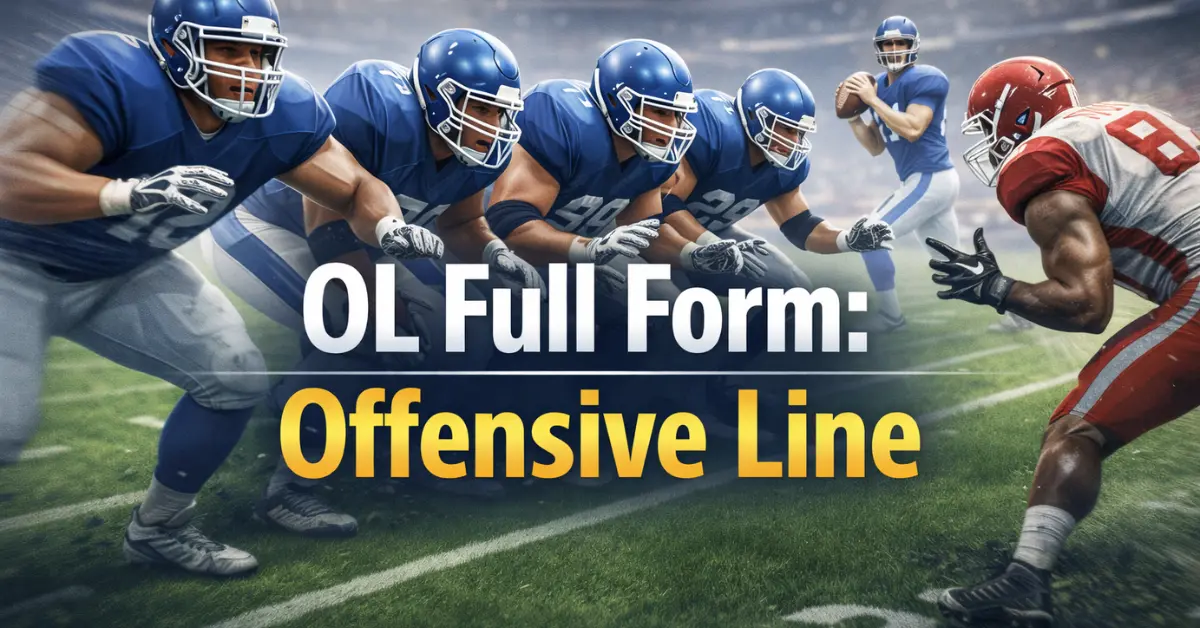
In American football, you may often hear commentators talk about “OL” during a game. But what does OL stand for, and why is it so important? In this article, we will break down the OL full form, its roles, positions, responsibilities, and why it’s the backbone of any football team.
What Does OL Stand For?
OL stands for Offensive Line.
The offensive line is a group of players whose main job is to:
- Protect the quarterback during passing plays.
- Create running lanes for running backs during rushing plays.
Without a strong OL, even the most talented quarterbacks and running backs would struggle to perform. They are the unsung heroes of the game, often doing the hard work behind the scenes.
OL Positions: Who Makes Up the Offensive Line?
The offensive line typically consists of five key positions:
Center (C)
- Snaps the ball to the quarterback to start each play.
- Makes line calls and adjusts blocking assignments.
Left Guard (LG) & Right Guard (RG)
- Positioned on either side of the center.
- Responsible for blocking interior defenders.
- Often “pull” to lead block on outside running plays.
Left Tackle (LT) & Right Tackle (RT)
- Positioned on the ends of the line.
- Protect the quarterback from fast edge rushers.
- Must combine strength and agility to block defenders.
Extra Tip: The LT often protects the quarterback’s blind side, making it one of the most critical positions on the OL.
Key Responsibilities of the OL
The offensive line has two main responsibilities:
Pass Blocking
- Prevent defenders from reaching the quarterback.
- Maintain a pocket for the QB to throw accurately.
Run Blocking
- Push defenders aside to open running lanes.
- Guide running backs toward open space.
Other responsibilities include:
- Communication: Adjusting blocks based on defensive alignment.
- Timing: Executing coordinated movements to maximize effectiveness.
- Adaptability: Reacting to blitzes and stunts by defensive players.
Physical and Mental Demands
Offensive linemen are often the largest players on the field, sometimes weighing over 300 pounds. But size alone isn’t enough. They must also have:
- Balance & leverage to counter defenders.
- Quick footwork for pass protection.
- Agility to pull and lead block on outside runs.
- Mental sharpness to read defenses and adjust in real-time.
Fun Fact: Despite their size, some professional tackles can run the 40-yard dash in under 5 seconds!
OL Alignment Basics
Modern football rules require:
- At least seven players on the line of scrimmage at the snap.
- Only the players at the ends (tight ends and wide receivers) are eligible to catch forward passes.
The five offensive linemen occupy the middle of the line and are ineligible to receive passes, focusing solely on blocking and protection.
Why the OL is Crucial for Team Success
The offensive line is often called the foundation of the offense because:
- Pass plays depend on OL protection to prevent sacks and turnovers.
- Running plays rely on OL blocks to gain consistent yardage.
- Team strategy is built around OL performance—strong lines allow more complex play-calling.
Without a cohesive OL, even elite quarterbacks and running backs can struggle to perform at their best.
Additional Insights Competitors Missed
- OL in Youth Football: Linemen may vary in size, emphasizing technique over strength.
- Coordination with Other Positions: OL works closely with the quarterback, running backs, and tight ends to execute plays effectively.
- Common Mistakes: Missed assignments or poor communication often lead to sacks, tackles for loss, or turnovers.
- NFL Examples: Teams like the Dallas Cowboys and Pittsburgh Steelers invest heavily in OL, showing its value at the professional level.
FAQs About OL in Football
What does OL mean in football?
OL stands for Offensive Line, the group of five players who protect the quarterback and block for running backs.
How many players are in the OL?
Five: Left Tackle, Left Guard, Center, Right Guard, and Right Tackle.
Can OL players catch the ball?
No, except for special situations. They are ineligible receivers in standard plays.
What makes a good offensive lineman?
Strength, balance, footwork, agility, communication, and game awareness.
Why is OL important?
They control the line of scrimmage, enabling successful passing and running plays.
Conclusion
The OL full form—Offensive Line—is more than just a group of large players on the field. They are the foundation of every offensive play, ensuring quarterbacks have time to throw and running backs can find space to advance. Understanding their roles, positions, and responsibilities gives you a deeper appreciation for the precision, teamwork, and strategy in football.
By mastering the offensive line’s importance, you can watch any football game with a new perspective and truly value the players who make success possible.
