
How to Negotiate Car Price. Buying a car is one of the biggest financial decisions most people make. Yet the majority of buyers walk into a dealership without a strategy, and they end up paying more than they should. The good news is that negotiating a car price is a skill anyone can learn.
This guide gives you everything you need to negotiate a new or used car price with confidence. You will learn what dealers know, what they do not want you to know, and exactly what to say at every stage of the process.
Why Negotiating a Car Price Still Matters
Some buyers assume that fixed-price dealerships or online car-buying platforms have made negotiation obsolete. That assumption is costly. Even at no-haggle dealerships, you can still negotiate add-ons, financing rates, trade-in values, and dealer fees.
Studies consistently show that buyers who research and negotiate save an average of $1,000 to $3,000 on a new car and even more on used vehicles. That money stays in your pocket when you come prepared.
Do Your Research Before You Walk In
The single biggest negotiation advantage is knowledge. The more you know about the car’s actual value, the more leverage you have.
Know the Invoice Price vs. the MSRP
MSRP (Manufacturer’s Suggested Retail Price) is the sticker price — the starting point for the dealer, not a fair price for you. The invoice price is what the dealer paid the manufacturer. Your target should be somewhere between invoice and MSRP, depending on demand.
Use tools like Edmunds, Kelley Blue Book (KBB), TrueCar, or CarGurus to find the invoice price, average transaction prices in your area, and fair market value for any car you want.
| Pricing Term | What It Means for You |
| MSRP (Sticker Price) | The starting point. Almost always negotiable on new cars. |
| Invoice Price | What the dealer paid. Aim to negotiate near or at this figure. |
| True Market Value (TMV) | Average price buyers in your area actually pay. |
| Dealer Holdback | A rebate (usually 2-3% of MSRP) dealers get from manufacturers — not often disclosed. |
| Destination Fee | A legitimate charge; non-negotiable but worth knowing. |
| Market Adjustment | An added markup above MSRP. Push back hard on this. |
Check Manufacturer Incentives and Rebates
Automakers regularly offer cash-back rebates, low-interest financing deals, and loyalty or conquest bonuses. Check the manufacturer’s official website and Edmunds Incentives page before visiting any dealer. These deals reduce what you owe before negotiations even begin.
Research the Used Car’s History and Value
For a used car, always obtain a vehicle history report from Carfax or AutoCheck. Check the car’s VIN for recalls on the NHTSA website. Then compare the asking price against KBB Private Party Value and similar listings on CarGurus and AutoTrader in your zip code.
Any accident history, prior rental or fleet use, or high mileage gives you negotiating leverage to ask for a lower price.
Get Pre-Approved Financing Before You Go
One of the most powerful moves a car buyer can make is to walk in with financing already arranged. Visit your bank or credit union and get pre-approved for an auto loan before setting foot in a dealership.
Here is why this matters: dealers make significant profit in the finance office. When you are pre-approved, you know your maximum interest rate. If the dealer offers a lower rate through their lender, accept it. If not, use your own financing. This removes one of the dealer’s biggest levers over you.
Pro Tip: Never reveal your pre-approved rate immediately. Let the dealer present their best finance offer first, then compare.
Get Competing Quotes from Multiple Dealerships
This is one of the most underused tactics in car negotiation, and it is highly effective. Contact at least three to five dealerships by email or phone. Ask each one for their out-the-door price on the exact same vehicle — same make, model, trim, and color.
When you receive competing quotes, you can use the lowest offer as leverage with every other dealer. You are not playing games; you are simply letting the market work in your favor.
Separate Every Deal Element — Never Bundle Them
Dealers are trained to bundle the car price, trade-in value, and monthly payment into one conversation. This is intentional. When everything is mixed together, it becomes very difficult to know whether you are actually getting a good deal.
Negotiate each element separately in this order:
- Agree on the out-the-door price of the car first.
- Then discuss your trade-in value.
- Then discuss financing and monthly payments.
- Finally, address any add-ons or extras.
Critical Warning: Never anchor the negotiation around a monthly payment. A dealer can stretch a loan to 72 or 84 months to make any car seem affordable. Always negotiate the total price first.
How to Negotiate a New Car Price

When negotiating a new car price, start below your target and work upward. If the invoice price is $32,000 and the MSRP is $35,000, open at $31,500 and be willing to settle around $32,200 to $32,800 depending on demand.
Tactics That Work When Negotiating a New Car
- Anchor with a specific number, not a range. Say: ‘I can do $31,500 out the door.’ Ranges invite the dealer to pick the higher end.
- Stay silent after making your offer. Silence is one of the most powerful negotiating tools. Resist the urge to fill the pause.
- Use the competing quote. Say: ‘I have a written quote from [Dealer X] for $31,800. Can you beat that?’
- Ask what the dealer can throw in if the price is firm. Free oil changes, floor mats, an extended warranty, or a full tank of gas have real value.
- Be ready to walk out. The single most powerful thing you can do is stand up and head for the door. Dealers know that a buyer who walks costs them a sale. Many will stop you with a better offer.
What to Say — and What Not to Say
| Say This | Not This |
| ‘What is your best out-the-door price?’ | ‘What are the monthly payments?’ |
| ‘I have a quote from another dealer for less.’ | ‘I really love this car.’ (Shows desperation) |
| ‘I am ready to sign today if the price is right.’ | ‘I need this car by this weekend.’ |
| ‘Is there anything else you can add at that price?’ | ‘What can we do to make this work?’ (Too open-ended) |
| ‘I will need to think about it.’ | Accepting the first counteroffer immediately. |
How to Negotiate a Used Car Price
Negotiating a used car price gives you more leverage than new because the value is less standardized. Every used car has a unique history, condition, and mileage that affects its worth.
Before You Negotiate a Used Car
- Pull the vehicle history report (Carfax or AutoCheck). Any accident, flood, or odometer irregularity is an instant bargaining chip.
- Have the car inspected by an independent mechanic before negotiating. A $100 to $150 inspection can reveal issues worth hundreds or thousands in deductions.
- Check how long the car has been listed. A car sitting on the lot for 45 or more days means the dealer is more motivated to sell.
- Compare the asking price to at least five similar listings in your area using KBB, CarGurus, and AutoTrader.
How to Use Defects to Negotiate
Once the mechanic’s inspection is complete, use every finding to reduce the price. If the brakes need replacement, get a quote from a shop and ask the dealer to deduct that cost. If the tires are worn, point that out. If the car has cosmetic scratches, photograph them and reference them in your offer.
You are not being difficult — you are being a smart buyer. Dealers expect this, and many will adjust the price rather than lose a sale.
Handle the Trade-In Strategically
Your trade-in is a separate transaction from the car you are buying. Treat it that way. Get your trade-in appraised before you go to the dealership. Use these sources:
- Carvana Instant Offer
- CarMax Appraisal
- Vroom
- KBB Instant Cash Offer
Walk into the dealer with a written offer in hand. If the dealer offers less than your best outside offer, you can tell them exactly that. This forces them to compete for your trade, or you can sell it privately for more and buy your new car with cash from that sale.
Key Tactic: Do not mention your trade-in until after you have agreed on the price of the car you are buying. Once the car price is locked, negotiate the trade-in as a second, separate deal.
Survive the Finance and Insurance (F&I) Office
The finance office is where many buyers lose money they saved in the showroom. The F&I manager will present several products at high profit margins. Know what to expect.
What the F&I Manager Will Offer
| Product | Should You Buy It? |
| Extended Warranty | Sometimes. Research the manufacturer’s certified pre-owned warranty first. Only buy if priced competitively — check online retailers like Endurance. |
| GAP Insurance | Yes, if financing more than 80% of the car’s value. But buy it from your own insurer, not the dealer — it will cost far less. |
| Paint/Fabric Protection | Usually no. This is one of the highest-markup items. A $25 can of sealant at a hardware store does the same job. |
| Tire and Wheel Protection | Depends. Can be worth it if you live in an area with rough roads. Negotiate the price down. |
| Credit Life/Disability Insurance | Rarely. You can get much better life/disability coverage elsewhere at a fraction of the cost. |
You are under no obligation to purchase any F&I product. Say clearly: ‘I am only interested in what we already agreed on. Please prepare the paperwork for just the vehicle and financing.’ If they push, stay firm and repeat the same sentence.
Know the Best Time to Buy a Car
Timing your purchase gives you real leverage. Dealers and salespeople have sales quotas, and those quotas create pressure that works in your favor.
- End of the month: Salespeople are chasing monthly quotas. They are more willing to cut deals on the last three to five days of any month.
- End of the quarter: Even more pressure — March, June, September, and December are typically the best months to negotiate.
- End of the model year: When new models arrive (usually August through October), dealers discount the outgoing year’s inventory aggressively. You can often save 10% or more.
- Weekdays over weekends: Less foot traffic means more attention and more flexibility from the salesperson.
- Holidays: Presidents’ Day, Memorial Day, Labor Day, and the day after Christmas are historically strong sales events with real discounts.
Read the Final Contract Carefully
Before you sign anything, review every line of the contract. Dealers have been known to add fees and products after a verbal agreement. Check for:
- The exact sale price you agreed upon
- All fees listed separately (doc fee, title fee, registration) — question any fee you did not discuss
- Your trade-in credit applied correctly
- The interest rate and loan term you agreed to
- No add-on products you declined in the F&I office
Take your time. You are not required to rush. If anything differs from what you agreed verbally, point it out and ask for a corrected document before signing.
Common Dealer Tactics and How to Counter Them
Understanding dealer psychology helps you stay in control during negotiations.
| Dealer Tactic | How to Counter It |
| ‘Let me go talk to my manager’ | Use this wait time to remain calm and rehearse your position. It is often a staged delay to wear you down. |
| ‘This deal is only good today’ | Artificial urgency. Say: ‘I understand. I will need to think about it.’ Good deals exist tomorrow too. |
| ‘What monthly payment works for you?’ | Deflect: ‘I am focused on the total out-the-door price, not the monthly payment.’ |
| ‘We only made $200 on this deal’ | Dealers have multiple profit centers. The car price, financing, and F&I products all add to their margin. |
| Adding market adjustment markups | Push back firmly: ‘I am not paying over MSRP. I have an offer from another dealer without that markup.’ |
| Bundling dealer add-ons already installed | Ask them to remove what you do not want, or ask for an equal credit toward something else. |
Online Car Buying: Can You Negotiate Remotely?
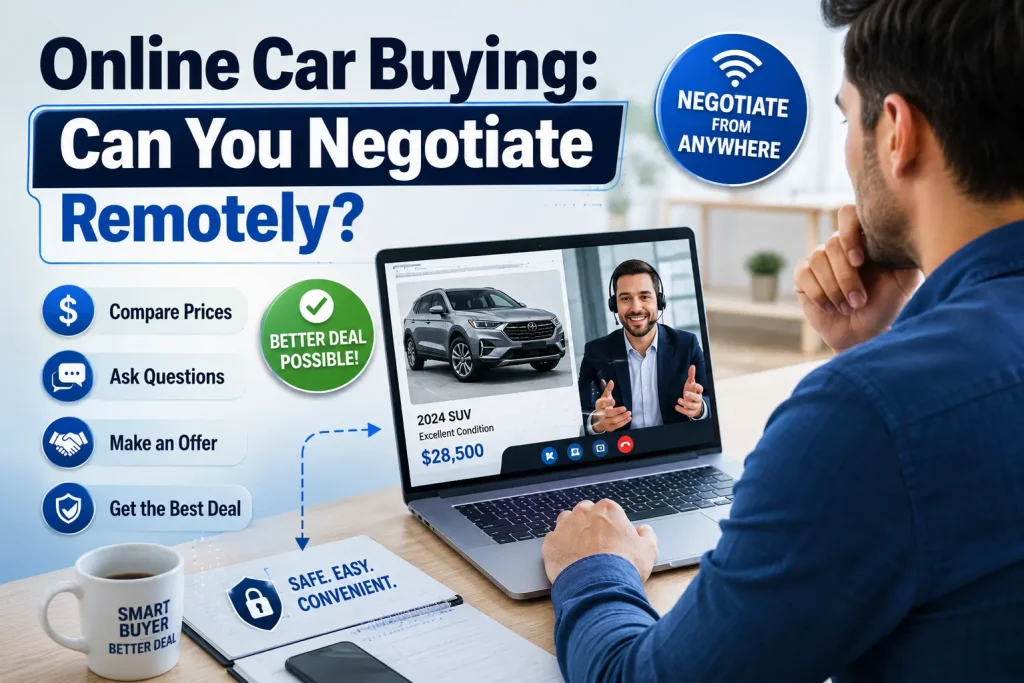
Yes. In fact, many experienced buyers negotiate the entire deal by email or phone before visiting the dealership. This approach removes the pressure of the showroom environment, lets you compare offers side by side, and gives you time to think.
When you arrive at the dealership, you are only there to confirm what was already agreed, do a test drive, and sign paperwork. If the dealer tries to change the terms in person, be prepared to leave.
Platforms like Costco Auto Program, TrueCar, and USAA Car Buying Service also connect you to pre-negotiated dealer pricing, which is a strong starting point — but you can still negotiate further from those prices on add-ons and trade-ins.
Negotiating a Car Price at a Private Sale
Buying from a private seller can get you a better price than a dealer, but it requires more caution.
- Always meet in a safe, public location or at a bank. Never handle large cash transactions at a private home.
- Bring a trusted mechanic or use a mobile inspection service.
- Check the title is clean and the VIN matches the car, the title, and the vehicle history report.
- Private sellers often price based on emotion. Pointing out comparable listings calmly and respectfully is the most effective way to negotiate.
- Offer to handle all paperwork promptly. Sellers appreciate a buyer who makes the process easy, and that goodwill can translate to a lower price.
Quick Reference: Negotiation Checklist
| Section | Details |
|---|---|
| Before You Visit the Dealership | Research invoice price and true market value on Edmunds and KBB. |
| Before You Visit the Dealership | Check for manufacturer rebates and incentives. |
| Before You Visit the Dealership | Get pre-approved financing from your bank or credit union. |
| Before You Visit the Dealership | Get your trade-in appraised at Carvana, CarMax, and KBB. |
| Before You Visit the Dealership | Pull the vehicle history report for any used car. |
| Before You Visit the Dealership | Contact 3-5 dealers for competing out-the-door quotes by email. |
| Before You Visit the Dealership | Schedule your visit near the end of the month. |
| At the Dealership | Negotiate the car price first — before tr |
Frequently Asked Questions
How much can you negotiate off a new car price?
Most new cars can be negotiated 3% to 8% below MSRP. Slow-selling or end-of-year models may offer 10% to 15% discounts, while high-demand cars may have little room for negotiation.
Is it rude to negotiate at a car dealership?
No, negotiation is completely normal. Dealers expect buyers to negotiate, so being respectful and prepared is perfectly acceptable.
What fees are negotiable at a dealership?
Dealer fees like doc fees, paint protection, VIN etching, or tire add-ons are often negotiable or removable. Government fees like tax, title, and registration are fixed.
Should I tell the dealer I am paying cash?
Avoid mentioning cash payment at first. Negotiate the car price first, then discuss how you plan to pay.
How do I negotiate a car price online?
Contact multiple dealers and ask for their best out-the-door price. Compare offers and use them to negotiate a better deal before visiting the dealership.
Final Thoughts
Negotiating a car price is not about being aggressive or confrontational. It is about being prepared, informed, and confident. Every tactic in this guide has been used by real buyers to save real money. The difference between a buyer who pays $2,000 more than necessary and one who drives away with a great deal almost always comes down to preparation.
Do your research. Get competing quotes. Keep each part of the deal separate. Know when to stay firm and when to walk away. And always review the final paperwork before you sign.
The car you want is out there. With the right approach, you can get it at a price you are proud of.
You May Also Like It:
Baylor Bears Mens Basketball vs Duke Blue Devils Mens Basketball Match Player Stats