

Introduction
If you’re a soccer fan, you’ve probably heard commentators talk about a CAM during games. But what does CAM actually mean? Don’t worry, by the end of this article, you’ll not only know the CAM full form, but you’ll also understand the role, responsibilities, and why this position is so crucial on the field.
What Is the CAM Full Form?
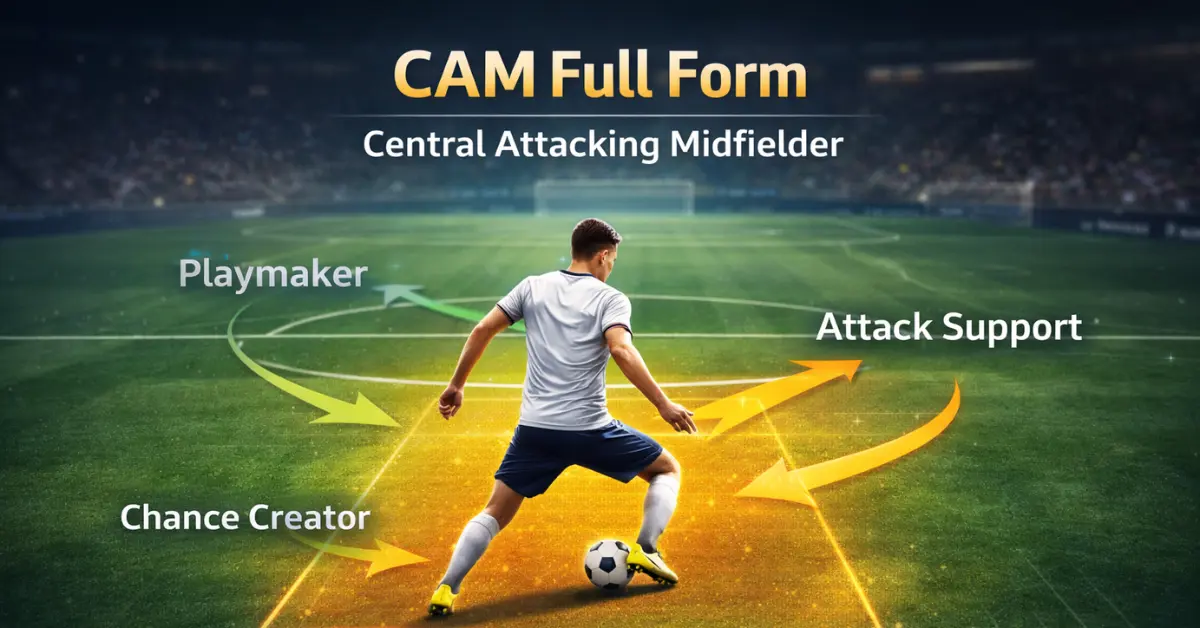
CAM stands for Central Attacking Midfielder.
As the name suggests, this player operates in the middle of the field, slightly ahead of the other midfielders, and just behind the striker. Think of them as the team’s creative engine – they’re the link between midfield and attack, always looking for opportunities to set up goals and control the flow of the game.
A CAM is not just about scoring goals themselves. They create chances, dictate tempo, and often make the players around them better. This position is one of the most important for a team’s attack because they can change the game in a single moment with a clever pass or a perfectly timed run.
Where Does a CAM Play on the Field?
Positioning is key for a CAM. Typically, they occupy the central areas of the pitch, but the best CAMs are not confined to one spot. They move between the midfield line and the attacking line, often dropping deep to help build attacks or drifting wide to pull defenders out of position.
Here’s what you can usually expect from a CAM’s positioning:
- Central pockets: Waiting for a pass between the defensive and midfield lines.
- Space creation: Drawing defenders out of position to open lanes for teammates.
- Supporting runs: Moving into spaces where they can receive the ball or combine with the striker.
Key Responsibilities of a CAM
Being a CAM is not easy – it requires intelligence, creativity, and technical skill. Here’s what a central attacking midfielder does in a match:
Creating Chances
The main job of a CAM is to find pockets of space and deliver decisive passes to forwards. Whether it’s a through ball splitting the defense or a short pass to a teammate, a CAM constantly looks for ways to turn small movements into goal-scoring opportunities.
Dictating the Tempo
A CAM decides whether the team should speed up or slow down the game. With good vision, they control the rhythm of play, helping the team maintain possession and push forward effectively.
Versatility
Great CAMs are adaptable. They can drift wide, drop deep, or push forward depending on the situation. Their flexibility allows the team to adjust tactics on the fly and keeps defenders guessing.
Defensive Organization
While CAMs are primarily offensive players, they still have defensive responsibilities. They work with the striker and midfielders to press opponents, cover spaces, and maintain the team’s shape when defending.
Traits of a Top CAM
To be an effective central attacking midfielder, players usually need:
- Vision: Spotting runs and knowing when and where to pass.
- Passing ability: Delivering accurate balls in all situations.
- Dribbling skills: Beating defenders to create space.
- Intelligent movement: Knowing when to move and where to receive the ball.
- Finishing ability: Scoring when the opportunity arises.
Famous CAMs in Soccer History
Some of the best CAMs in the world have become legends because of their creativity and influence on the game:
- Zinedine Zidane: Known for his elegance, vision, and flair.
- Diego Maradona: Legendary dribbler who dominated between midfield and attack.
- Ronaldinho: A magician with the ball, capable of creating chances from nothing.
- Thomas Muller: Famous as a “space investigator,” always finding the perfect spot to attack.
Each of these players has shown just how important the CAM role can be in shaping a team’s offense and controlling games.
Conclusion
So, the CAM full form is Central Attacking Midfielder, a position that demands creativity, awareness, and versatility. Whether you’re watching a game or playing FIFA, knowing what a CAM does will give you a better understanding of soccer tactics and why certain players shine on the pitch.
