

Best Bike Lights:
Riding in low light without a proper lighting setup is one of those risks that cyclists routinely underestimate — until something goes wrong. The right bike lights do two separate jobs: they help you see what is ahead, and they make sure drivers and pedestrians can see you coming. Those are not the same thing, and conflating them leads to poor purchasing decisions.
This guide cuts through the marketing noise and gives you honest, practical advice on choosing front and rear lights that actually work for the way you ride.
What Most Buying Guides Get Wrong
Before getting into recommendations, it is worth addressing the gaps that most articles leave open.
Lumens are not the whole story. Every manufacturer leads with lumen counts because it is an easy number to compare. But a 1,000-lumen light with a well-shaped beam will outperform a 2,000-lumen light that scatters its output in all directions. Beam shape — how the light is focused and distributed — matters just as much as raw brightness. A tight, focused beam throws light further down the road. A flood beam spreads wide, which is better for off-road riding where obstacles appear from the sides. For urban riding, a cutoff beam (one that does not project upward) prevents you from blinding oncoming traffic and pedestrians.
Battery life claims are optimistic. Manufacturers test lights under controlled conditions. In cold weather, at maximum brightness, or after the battery has aged, real-world performance is typically 20 to 30 percent lower than the advertised figure. A practical workaround: buy a light that is brighter than you need and run it at a lower setting. You get longer battery life and a comfortable reserve of brightness when you need it.
Mounting quality is a safety issue. A light that works loose at 40 km/h on a descent is a hazard, not just an inconvenience. Cheap plastic mounts flex and loosen over time. If you are running a heavy or powerful light, look for a metal mount with a locking mechanism rather than a simple rubber band.
Side visibility is routinely ignored. Most front lights project forward, and most rear lights project backward. But many accidents at intersections happen because a driver crossing your path cannot see you from the side. Some lights include side-facing LED strips or angled secondary emitters. These are worth paying attention to, particularly for urban commuters.
Choosing by Riding Type
The right light depends heavily on where and when you ride.
City commuting does not require extreme brightness. In a lit urban environment, 400 to 600 lumens is sufficient for a front light. What matters more is compact size, a reliable mount, and a charge indicator so you are not caught off guard. A flashing rear light with at least 50 lumens completes the setup.
Night road riding calls for something more substantial. On unlit roads, you need enough light to see surface changes, potholes, and junctions well before you reach them. An 800 to 1,200 lumen front light with a wide beam pattern is the appropriate range. Pair this with a rear light that has both solid and flash modes.
Gravel and off-road riding demands the most from a lighting setup. Trails are unpredictable — roots, rocks, and drops appear quickly and from unexpected angles. Here, 1,500 lumens or more is a sensible starting point, and beam width becomes critical. A light that focuses all its output in a narrow cone ahead is not appropriate for trail riding.
Waterproof Ratings, Explained Simply
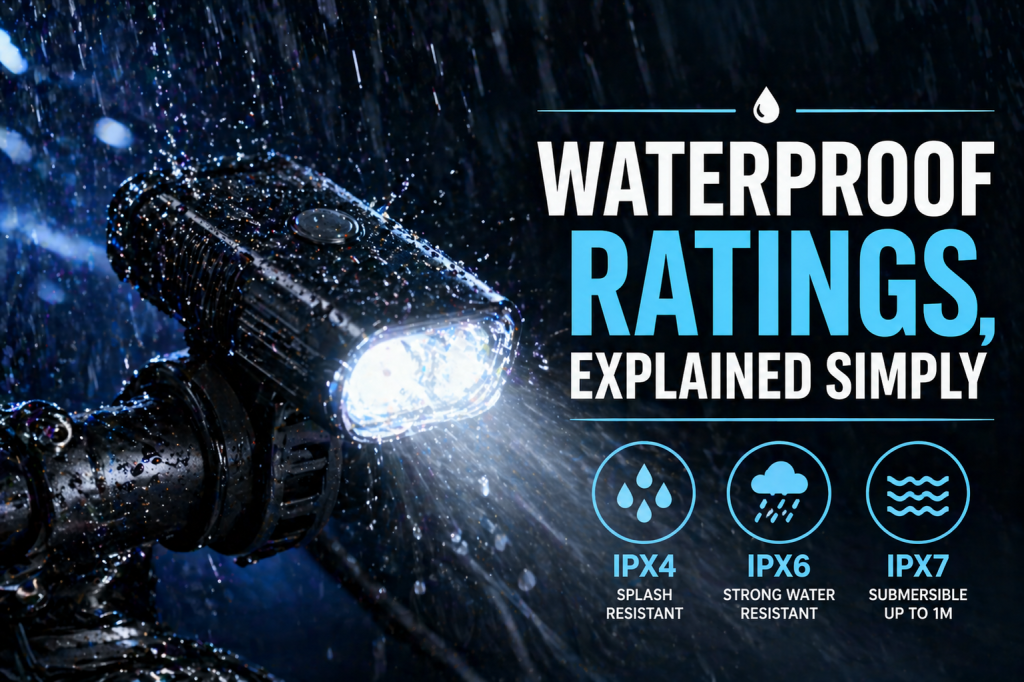
The IPX rating system tells you how resistant a light is to water. For cycling, the relevant ratings are:
- IPX4 means the light can handle splashing from any direction — adequate for light rain.
- IPX5 handles a sustained stream of water, suitable for moderate rain.
- IPX6 withstands powerful jets of water, which covers heavy downpours and spray from wet roads.
- IPX7 means the unit can be submerged briefly — more than most cyclists will ever need.
For general use, IPX6 is the recommended minimum. It handles realistic wet weather without being overkill.
Battery and Charging
Modern lights use lithium-ion batteries and charge via USB. USB-C is now the standard on better units, which is worth seeking out for compatibility with your existing cables. Avoid lights that rely on proprietary charging connectors or disposable alkaline batteries — these formats are outdated and inconvenient.
One practical detail: some cheaper lights cut off abruptly when the battery runs low. Better-designed lights reduce brightness gradually, giving you warning time to reach your destination or find somewhere to stop safely. This behaviour is rarely advertised, but it is easy to identify in user reviews.
Smart Features: Worth It or Not?
Several manufacturers now offer lights with automatic brightness adjustment based on ambient light, brake detection (using a built-in accelerometer), radar integration with cycling computers, and app-based controls.
These features are genuinely useful once you are used to them, but they add cost and complexity. For most riders, they are not essential. If you are building your first proper setup, focus on getting the fundamentals right — good beam quality, reliable battery, and a solid mount — before adding smart features.
A Sensible Setup for Most Riders
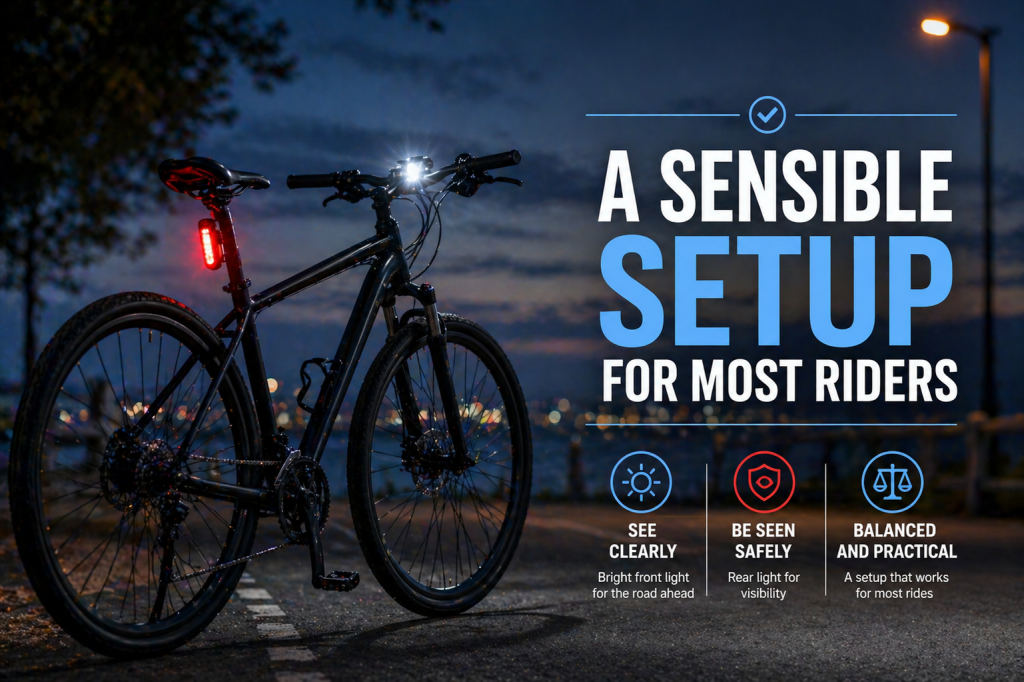
For the majority of road and commuter cyclists, the following combination covers the bases:
A front light in the 800 to 1,200 lumen range, with USB-C charging and IPX6 waterproofing. Run it on a medium setting for day-to-day riding and reserve maximum output for dark, unlit roads.
A rear light with 100 to 300 lumens, a flash mode for daytime visibility, and a solid mode for night riding where flash patterns can be disorienting to drivers behind you.
A small backup light — something clip-on and inexpensive — carried in a jersey pocket or bag. On longer rides, this is straightforward insurance against a flat battery.
If you frequently ride on roads with fast traffic, a helmet-mounted light adds meaningful visibility when you look sideways to check for vehicles before turning.
Common Mistakes Worth Avoiding
Buying purely on lumen count leads many cyclists toward lights that are technically bright but poorly designed. Check beam shape information and user reviews before committing.
Running lights at maximum brightness constantly shortens battery life and thermal performance. Learn the settings on your lights and use them strategically.
Neglecting the rear light is surprisingly common. Drivers approaching from behind rely entirely on your rear light to know you are there. It deserves the same attention as the front.
Ignoring the mount until it fails is another frequent oversight. Inspect mounts occasionally, particularly after rough terrain, and replace rubber straps before they crack.
Frequently Asked Questions
How many lumens do I actually need?
For city riding, 400 to 600 is sufficient. For unlit roads at night, aim for 800 to 1,200. Off-road night riding warrants 1,500 or more.
Are expensive lights worth the money?
Generally, yes — but not for the reason most people assume. The difference between a budget and premium light is less often about raw brightness and more about battery management, mount quality, and reliability over time. A light that fails in the rain or dies unexpectedly mid-ride is worse than useless.
Should lights flash or stay solid?
Both, ideally. A flashing pattern is more attention-grabbing in daylight and at dusk. A solid beam is better for actually seeing the road ahead at night. If you can only have one mode, a solid beam is the priority for the front light, and a flash is the priority for the rear.
Do I need lights in daylight?
Yes. Studies consistently show that daytime running lights — particularly flashing rear lights — reduce the likelihood of being struck from behind. Many professional cyclists now run lights during all hours.
Final Thoughts
The best bike light is not the one with the highest lumen count or the most features. It is the one you will reliably charge, mount correctly, and use on every ride. Start with a solid front light in the 800 to 1,200 lumen range and a dependable rear light, and build from there based on your actual riding conditions. Good lighting is not an accessory — it is the most important safety equipment on your bike after your helmet.
You May Also Like It:
Pedrovazpaulo Business Consultant
Boost Website Traffic with Garage2Global
Cross-Platform App Development by Garage2Global
Arizona Wildcats Mens Basketball vs Duke Blue Devils Mens Basketball Match Player Stats
