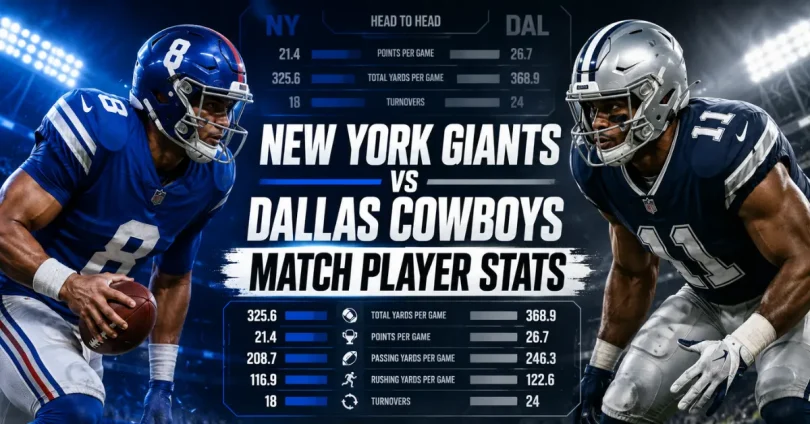

The latest New York Giants vs Dallas Cowboys match player stats tell the story of a game New York controlled through efficient quarterback play, a balanced rushing attack, reliable kicking, and strong third-down execution.
The Giants defeated the Cowboys 34-17 at MetLife Stadium on January 4, 2026. New York outgained Dallas 380-286, produced 25 first downs, converted eight of 14 third-down attempts, and avoided throwing an interception. Dallas moved the ball effectively on the ground but struggled to create enough passing plays to keep pace.
Jaxson Dart led the winning offense with 230 passing yards and two touchdowns. Tyrone Tracy Jr. added 159 yards from scrimmage, while Gunner Olszewski finished as the game’s leading receiver with 102 yards.
This breakdown covers the final score, player statistics, team numbers, standout performances, turning points, recent results, and the all-time Cowboys-Giants rivalry record.
Giants vs Cowboys Game Overview
| Game detail | Information |
|---|---|
| Matchup | Dallas Cowboys at New York Giants |
| Date | January 4, 2026 |
| Venue | MetLife Stadium |
| Final score | Giants 34, Cowboys 17 |
| Leading passer | Jaxson Dart, 230 yards |
| Leading rusher | Tyrone Tracy Jr., 103 yards |
| Leading receiver | Gunner Olszewski, 102 yards |
| Turnover advantage | Giants, 2 takeaways to 1 |
| Total yards | Giants 380, Cowboys 286 |
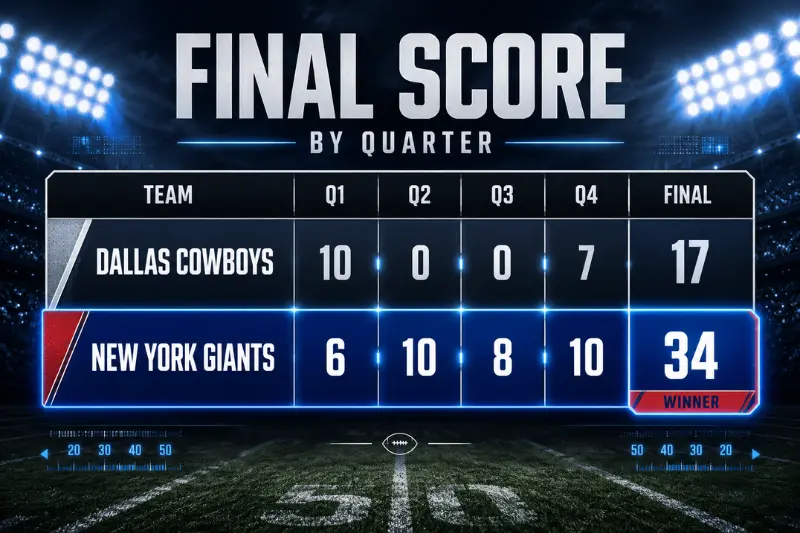
New York led 16-10 at halftime and continued to create separation after the break. The Giants scored in every quarter and finished the game with 10 fourth-quarter points.
Dallas remained within reach during the first half, but its passing attack did not generate enough production after halftime. The Cowboys finished with only 143 team passing yards and failed to score in either the second or third quarter.
Final Score by Quarter
| Team | Q1 | Q2 | Q3 | Q4 | Final |
|---|---|---|---|---|---|
| Dallas Cowboys | 10 | 0 | 0 | 7 | 17 |
| New York Giants | 6 | 10 | 8 | 10 | 34 |
The quarter-by-quarter scoring shows how steadily New York built its advantage.
Dallas started well and led 10-6 after the first quarter. However, the Giants answered with 10 points in the second quarter, eight in the third, and another 10 in the fourth.
That consistency mattered. New York never went an entire quarter without scoring, while Dallas went scoreless for the middle two quarters.
New York Giants Player Stats
Giants Passing Stats
| Player | Completions/Attempts | Passing yards | TD | INT | Passer rating |
|---|---|---|---|---|---|
| Jaxson Dart | 22/32 | 230 | 2 | 0 | 110.2 |
| Gunner Olszewski | 0/1 | 0 | 0 | 0 | 39.6 |
Jaxson Dart delivered the most efficient quarterback performance of the game.
He completed 68.8 percent of his passes and averaged 7.2 yards per attempt. More importantly, he threw two touchdowns without an interception.
Dart was sacked four times, but those pressures did not lead to costly mistakes. He continued moving the offense, helped New York convert third downs, and finished with a 110.2 passer rating.
His ability to protect the football created a major contrast with Dallas, which threw an interception and lost a fumble.
Giants Rushing Stats
| Player | Carries | Rushing yards | Average | TD | Long |
|---|---|---|---|---|---|
| Tyrone Tracy Jr. | 18 | 103 | 5.7 | 0 | 20 |
| Jaxson Dart | 5 | 32 | 6.4 | 0 | 13 |
| Devin Singletary | 9 | 26 | 2.9 | 1 | 13 |
Tyrone Tracy Jr. gave the Giants the consistent ground threat they needed.
He crossed the 100-yard mark on 18 attempts and averaged 5.7 yards per carry. His 20-yard run was the longest rushing play by a Giants player.
Dart also contributed 32 rushing yards, giving New York another way to challenge the Dallas defense. Devin Singletary did not average as many yards per attempt, but he added an important rushing touchdown.
The Giants finished with 161 rushing yards on 32 carries, an average of just over five yards per attempt.
Giants Receiving Stats
| Player | Receptions | Receiving yards | Average | TD | Targets |
|---|---|---|---|---|---|
| Gunner Olszewski | 8 | 102 | 12.8 | 0 | 9 |
| Tyrone Tracy Jr. | 8 | 56 | 7.0 | 1 | 9 |
| Daniel Bellinger | 2 | 38 | 19.0 | 1 | 2 |
| Darius Slayton | 4 | 34 | 8.5 | 0 | 9 |
Gunner Olszewski led all players with 102 receiving yards. He caught eight of his nine targets and produced a game-long reception of 28 yards.
His performance gave the Giants a dependable target who could move the chains and create yards beyond short routes.
Tracy was equally important as a receiver. He caught eight passes for 56 yards and one touchdown, giving him 159 total yards from scrimmage.
Daniel Bellinger made the most of his limited opportunities. He caught both of his targets for 38 yards and a touchdown, averaging 19 yards per reception.
Giants Defensive Leaders
| Player | Total tackles | Solo tackles | Sacks | Passes defended |
|---|---|---|---|---|
| Dane Belton | 13 | 8 | 0 | 0 |
| Rico Payton | 7 | 3 | 0 | 1 |
| Bobby Okereke | 6 | 3 | 0 | 1 |
| Raheem Layne | 4 | 4 | 0 | 0 |
| Darius Alexander | 4 | 2 | 0 | 0 |
Dane Belton led New York with 13 total tackles and eight solo stops.
Bobby Okereke provided the most important defensive takeaway. He intercepted a Dallas pass and returned it seven yards. He also recorded six tackles and defended another pass.
The Giants did not record a sack, but their defense succeeded by limiting completions, protecting the end zone, and forcing two Dallas turnovers.
Giants Kicking and Special Teams
| Player | Category | Performance |
|---|---|---|
| Ben Sauls | Field goals | 4/4 |
| Ben Sauls | Longest field goal | 45 yards |
| Ben Sauls | Extra points | 2/2 |
| Gunner Olszewski | Punt returns | 2 returns, 27 recorded individual yards |
| Deonte Banks | Kick returns | 2 returns, 64 yards |
Ben Sauls was one of New York’s most valuable players.
He converted all four of his field-goal attempts, including a 45-yarder, and made both extra-point attempts. His 14 total kicking points gave the Giants a reliable scoring option whenever a drive stopped before the end zone.
Without Sauls’ field goals, Dallas would have remained within striking distance for much longer.
Dallas Cowboys Player Stats
Cowboys Passing Stats
| Player | Completions/Attempts | Passing yards | TD | INT | Passer rating |
|---|---|---|---|---|---|
| Joe Milton III | 7/13 | 73 | 0 | 1 | 38.3 |
| Dak Prescott | 7/11 | 70 | 0 | 0 | 81.6 |
| Team total | 14/24 | 143 | 0 | 1 | 58.1 |
Dallas used both Dak Prescott and Joe Milton III, but neither quarterback threw a touchdown.
Prescott completed seven of 11 attempts for 70 yards. Milton completed seven of 13 passes for 73 yards but threw the game’s only interception.
The Cowboys averaged six yards per pass attempt, but they failed to produce a passing touchdown. Their quarterbacks combined for only 143 yards, 87 fewer than Dart’s individual total.
Dallas also struggled to extend drives through the air. Its limited passing production became especially damaging after New York built a two-score advantage.
Cowboys Rushing Stats
| Player | Carries | Rushing yards | Average | TD | Long |
|---|---|---|---|---|---|
| Jaydon Blue | 16 | 64 | 4.0 | 1 | 27 |
| Joe Milton III | 4 | 43 | 10.8 | 0 | 23 |
| Phil Mafah | 5 | 18 | 3.6 | 1 | 8 |
| Hunter Luepke | 2 | 12 | 6.0 | 0 | 9 |
| KaVontae Turpin | 1 | 7 | 7.0 | 0 | 7 |
| Dak Prescott | 2 | -1 | -0.5 | 0 | 0 |
The rushing attack was the strongest part of the Dallas offense.
Jaydon Blue led the Cowboys with 64 yards and one touchdown. His 27-yard run was the longest rushing play of the game.
Milton added 43 yards on only four attempts, averaging 10.8 yards per carry. Phil Mafah scored Dallas’ other rushing touchdown.
The Cowboys finished with 143 rushing yards and averaged 4.8 yards per attempt. Those are respectable numbers, but the running game could not compensate for the lack of passing touchdowns and poor third-down performance.
Cowboys Receiving Stats
| Player | Receptions | Receiving yards | Average | TD | Targets |
|---|---|---|---|---|---|
| Ryan Flournoy | 5 | 68 | 13.6 | 0 | 7 |
| Brevyn Spann-Ford | 2 | 30 | 15.0 | 0 | 3 |
| Luke Schoonmaker | 1 | 12 | 12.0 | 0 | 1 |
| Phil Mafah | 2 | 11 | 5.5 | 0 | 2 |
| George Pickens | 1 | 9 | 9.0 | 0 | 3 |
| Jake Ferguson | 1 | 5 | 5.0 | 0 | 2 |
| CeeDee Lamb | 1 | 4 | 4.0 | 0 | 1 |
Ryan Flournoy was Dallas’ leading receiver with five catches for 68 yards.
He produced the Cowboys’ longest passing play, a 33-yard reception, and accounted for nearly half of the team’s passing yards.
However, Dallas received very little production from several of its other receiving options. George Pickens, Jake Ferguson, and CeeDee Lamb combined for only 18 yards.
No Cowboys player caught a touchdown pass.
Cowboys Defensive Leaders
| Player | Total tackles | Sacks | Tackles for loss | QB hits |
|---|---|---|---|---|
| Shemar James | 13 | 0.5 | 0 | 1 |
| Sam Williams | 8 | 0 | 1 | 0 |
| Logan Wilson | 7 | 0 | 0 | 0 |
| Jadeveon Clowney | 6 | 3 | 4 | 3 |
| Reddy Steward | 6 | 0 | 0 | 0 |
| Caelen Carson | 6 | 0 | 1 | 0 |
Jadeveon Clowney was Dallas’ most disruptive defender.
He recorded three sacks, four tackles for loss, three quarterback hits, and a pass defended. His pressure prevented New York from turning every possession into a long scoring drive.
Shemar James led the Cowboys with 13 total tackles and shared a sack. Dallas finished with four team sacks and nine quarterback hits.
The defense created pressure, but it remained on the field for 69 plays because the Cowboys’ offense struggled to maintain possession.
Cowboys Kicking and Returns
| Player | Category | Performance |
|---|---|---|
| Brandon Aubrey | Field goals | 1/2 |
| Brandon Aubrey | Longest made field goal | 22 yards |
| Brandon Aubrey | Extra points | 2/2 |
| KaVontae Turpin | Kick returns | 7 returns, 215 yards |
| Bryan Anger | Punting | 2 punts, 110 yards |
KaVontae Turpin delivered one of Dallas’ best special-teams performances, returning seven kickoffs for 215 yards. His longest return covered 84 yards.
That return ability repeatedly gave Dallas opportunities to start drives with favorable field position. The offense, however, did not turn enough of those opportunities into touchdowns.
Brandon Aubrey made one of two field-goal attempts and both extra points.
Top Five Performers
1. Jaxson Dart
Dart provided the Giants with the game’s best quarterback performance.
He completed 22 of 32 passes for 230 yards, threw two touchdowns, avoided an interception, and added 32 rushing yards.
His composure mattered because Dallas recorded four sacks and nine quarterback hits. Despite that pressure, Dart protected the football and continued producing successful drives.
2. Tyrone Tracy Jr.
Tracy was New York’s most complete offensive player.
He recorded:
- 103 rushing yards
- 56 receiving yards
- Eight receptions
- One receiving touchdown
- 159 total yards from scrimmage
Dallas had to account for him both in the backfield and as a receiver, which created more options for the rest of New York’s offense.
3. Gunner Olszewski
Olszewski led all receivers with eight catches for 102 yards.
Seven of his nine targets resulted in either a catch or an incompletion, showing how frequently Dart looked in his direction. His ability to gain yards downfield helped prevent Dallas from focusing only on the Giants’ running game.
4. Ben Sauls
Sauls scored 14 points by himself.
He made all four field goals and both extra points. His perfect kicking performance helped New York convert stalled possessions into points and maintain control of the scoreboard.
5. Jadeveon Clowney
Clowney stood out despite the Cowboys’ loss.
His three sacks and four tackles for loss repeatedly disrupted the Giants. Without his pressure, New York’s yardage and scoring totals could have been even higher.
Quarterback Comparison
| Statistic | Jaxson Dart | Dallas quarterbacks |
|---|---|---|
| Completions | 22 | 14 |
| Attempts | 32 | 24 |
| Completion rate | 68.8% | 58.3% |
| Passing yards | 230 | 143 |
| Passing TDs | 2 | 0 |
| Interceptions | 0 | 1 |
| Yards per attempt | 7.2 | 6.0 |
The quarterback comparison was the clearest difference between the two teams.
Dart completed a higher percentage of his passes, generated 87 more passing yards, threw two touchdowns, and avoided turnovers.
Dallas split its attempts between Prescott and Milton. That approach did not produce enough rhythm or explosive passing plays.
The Cowboys ran the ball well, but once they fell behind, their passing attack was not productive enough to lead a comeback.
Team Stats Comparison
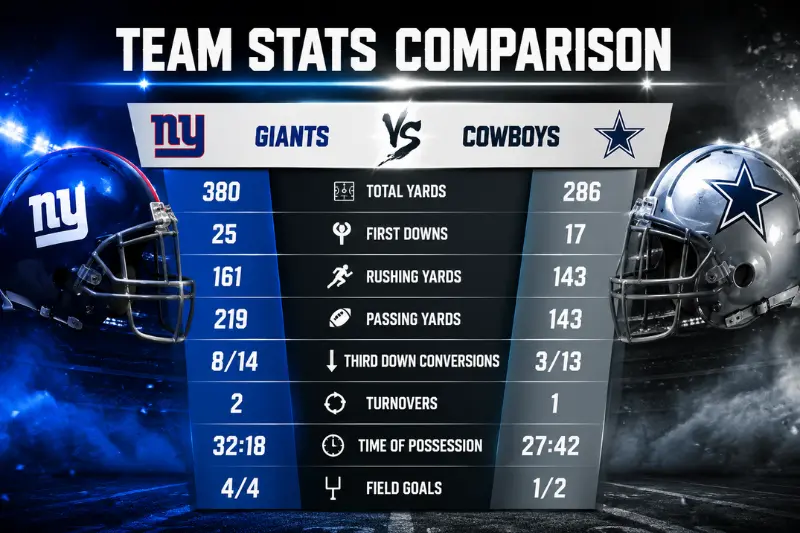
| Statistic | Cowboys | Giants |
|---|---|---|
| First downs | 18 | 25 |
| Total plays | 54 | 69 |
| Total yards | 286 | 380 |
| Yards per play | 5.3 | 5.5 |
| Passing yards | 143 | 219 net |
| Rushing yards | 143 | 161 |
| Third-down conversions | 2/8 | 8/14 |
| Fourth-down conversions | 1/2 | 0/0 |
| Interceptions thrown | 1 | 0 |
New York gained 94 more total yards and ran 15 more offensive plays. The Giants also generated seven more first downs.
The yards-per-play numbers were relatively close, but New York sustained drives more effectively. That allowed the Giants to run more plays and create additional scoring chances.
The Statistic That Decided the Game
The biggest difference was third-down efficiency.
New York converted eight of 14 third downs, a success rate of 57.1 percent. Dallas converted only two of eight, a rate of 25 percent.
That gap affected nearly every part of the game.
Successful third-down conversions allowed the Giants to:
- Keep drives alive
- Run 15 more plays
- Produce seven more first downs
- Give their defense more rest
- Create additional field-goal opportunities
- Prevent Dallas from building offensive rhythm
Dallas averaged a respectable 5.3 yards per play, but its possessions ended too quickly. New York was only slightly better at 5.5 yards per play, yet its ability to convert important downs created a much larger advantage on the scoreboard.
Four Reasons the Giants Won
1. Efficient quarterback play
Dart threw two touchdowns without an interception. Dallas failed to record a passing touchdown and threw one interception.
2. A balanced offense
New York produced 230 gross passing yards and 161 rushing yards. Tracy’s ability to contribute as both a runner and receiver prevented the Cowboys from defending one dimension of the offense.
3. Better drive extension
The Giants converted more than half of their third downs. Dallas converted only two.
4. Reliable kicking
Sauls turned four possessions into 12 field-goal points. His accuracy prevented the Giants from leaving points on the field.
Where the Cowboys Fell Short
Dallas did several things well. The Cowboys ran for 143 yards, recorded four sacks, and received 215 kick-return yards from Turpin.
However, four problems limited their chances:
- No passing touchdowns
- Only 143 passing yards
- Two successful third-down conversions
- Two turnovers
- No points in the second or third quarter
The lack of production during the middle of the game was especially costly. New York turned a four-point first-quarter deficit into a 24-10 advantage before Dallas scored again.
Underrated Performance: Daniel Bellinger
Bellinger’s stat line was small compared with those of Tracy and Olszewski, but his efficiency deserves attention.
He caught both of his targets for 38 yards and a touchdown. His 19 yards per reception led the Giants.
Players who produce on limited opportunities can change games without receiving a high number of targets. Bellinger did exactly that.
Recent Cowboys vs Giants Results
| Date | Result |
|---|---|
| January 4, 2026 | Giants 34, Cowboys 17 |
| September 14, 2025 | Cowboys 40, Giants 37, overtime |
| November 28, 2024 | Cowboys 27, Giants 20 |
| September 26, 2024 | Cowboys 20, Giants 15 |
| November 12, 2023 | Cowboys 49, Giants 17 |
| September 10, 2023 | Cowboys 40, Giants 0 |
The January 2026 result ended a long period of Dallas dominance in the series. The Cowboys had won the previous eight meetings before New York’s 34-17 victory.
The September 2025 meeting was much closer. Dallas won 40-37 in overtime after a high-scoring quarterback duel.
Cowboys vs Giants All-Time Record
Following the January 4, 2026 game, Dallas leads the overall rivalry 78-48-2.
The regular-season record stands at 78-47-2 in favor of the Cowboys. The teams have met once in the playoffs, with the Giants winning that postseason matchup 21-17 in January 2008.
Rivalry snapshot
| Category | Record |
|---|---|
| Overall series leader | Dallas Cowboys |
| Overall record | Cowboys 78-48-2 |
| Regular-season record | Cowboys 78-47-2 |
| Playoff record | Giants 1-0 |
| First meeting | December 4, 1960 |
| First result | 31-31 tie |
| Latest completed meeting | Giants 34-17, January 4, 2026 |
The history remains heavily tilted toward Dallas, but New York owns the only postseason victory between the teams.
What These Player Stats Reveal
Raw box-score totals do not always explain a game clearly. In this matchup, the deeper numbers reveal several useful points.
Dallas was not ineffective on every play
The Cowboys averaged 5.3 yards per play, only 0.2 fewer than New York. Their problem was not a complete inability to gain yards. It was their failure to turn productive early-down plays into extended drives and touchdowns.
New York created more usable possessions
The Giants ran 69 plays compared with Dallas’ 54. Even with a similar average gain, 15 additional plays created more chances to move the chains and score.
Tracy was more valuable than his rushing total alone suggests
His 103 rushing yards tell only part of the story. Adding his 56 receiving yards shows that he generated 159 yards from scrimmage and affected both the running and passing games.
Special teams helped both sides differently
Turpin gave Dallas excellent return yardage, while Sauls gave New York guaranteed points. New York’s special-teams contribution had the greater direct impact on the final score.
Key Takeaways
- The Giants defeated the Cowboys 34-17.
- Jaxson Dart threw for 230 yards, two touchdowns, and no interceptions.
- Tyrone Tracy Jr. generated 159 yards from scrimmage.
- Gunner Olszewski led all receivers with 102 yards.
- Ben Sauls made all four of his field-goal attempts.
- New York outgained Dallas 380-286.
- The Giants converted eight third downs, while Dallas converted only two.
- Dallas recorded four sacks but could not overcome its limited passing production.
- The Cowboys still lead the all-time series 78-48-2.
Frequently Asked Questions
Who won the latest completed Giants vs Cowboys game?
The New York Giants defeated the Dallas Cowboys 34-17 on January 4, 2026, at MetLife Stadium.
Who had the most passing yards?
Jaxson Dart led the game with 230 passing yards. He completed 22 of 32 attempts and threw two touchdowns.
Who was the leading rusher?
Tyrone Tracy Jr. led all players with 103 rushing yards on 18 carries.
Who had the most receiving yards?
Gunner Olszewski finished with a game-high 102 receiving yards on eight catches.
Which player scored the most points?
Giants kicker Ben Sauls scored 14 points. He made four field goals and two extra points.
Did Dak Prescott throw a touchdown?
No. Prescott completed seven of 11 passes for 70 yards but did not throw a touchdown.
How many turnovers did Dallas commit?
Dallas committed two turnovers, one interception and one lost fumble. New York committed one turnover on a fumble.
Which defense recorded the most sacks?
Dallas recorded four sacks. Jadeveon Clowney led the Cowboys with three.
What is the all-time Cowboys vs Giants record?
Dallas leads the overall series 78-48-2, including the teams’ only playoff meeting.
Have the Giants and Cowboys played in the postseason?
Yes. They met in the NFC Divisional Round in January 2008. The Giants won 21-17 and hold a 1-0 playoff record against Dallas.
Final Analysis
The New York Giants vs Dallas Cowboys match player stats show that New York won through consistency rather than one isolated play.
Dart delivered the more efficient quarterback performance. Tracy created value as a runner and receiver. Olszewski led the passing game, while Sauls converted every kicking opportunity.
Dallas produced useful rushing numbers, strong kickoff returns, and four sacks. However, the Cowboys could not sustain enough drives or generate enough passing production. Their 25 percent third-down conversion rate, two turnovers, and two scoreless middle quarters left them unable to match New York’s steady output.
The Giants’ 34-17 win did not erase Dallas’ large historical advantage in the rivalry, but it gave New York a convincing season-ending victory and ended the Cowboys’ eight-game winning run in the series.